When should you transfer your brokerage account?
As a risk analyst, I suppose it’s not too far off to say that I’m also a paranoid individual. No, I’m not looking over my shoulder, waiting for the bogeyman to get me — rather, I now rarely take anything anyone says to me at face value. I guess you can call me a skeptic. I’m constantly looking for the downside of the hard sell, the underlying truth to the glossed over public image. In other words, I firmly believe that there are untruths being hidden behind every smile and firm handshake in an attempt to separate my bank from every penny it earns.
I do this for two reasons: one, it’s a great attribute to have when ferreting out risk. And two, it’s just my nature. This paranoia carries through to my personal life as well. I am extremely careful when it comes to whom I trust for my money and personal information. Needless to say, this is one of the reasons why my husband and I maintain separate bank accounts: unfortunately, I just don’t trust his bank. It’s not that I think that people are out to get me. That’s not it at all. It’s just that I know that every business out there is out to make money. Some do it more ethically than others — that’s all.

Image from thestreet.com
So, now that I am entering into the wonderful world of investing (I’m a new stock investor), I have lain awake some nights wondering just how trustworthy the banks, financial institutions and brokerages are, and how much of my money could disappear before I realize what’s going on. Of course, a lot that could happen may very well be our very own fault. But it’s also important to be aware about what things that are not our fault could cause our fortunes to diminish. After all, it hasn’t been too long since the financial crisis ran off with the real estate values and retirement savings of so many hardworking Americans. In fact, the subprime lending mess and borrowing bust were pretty much part of a massive scam that a whole lot of people in the financial industry participated in.
Identify Stock Broker Fraud & Bad Advice: When To Fire Your Broker
When we think of “scam”, there’s a lot out there that are circulating: check out this discussion on safe shopping and this article on internet scams. It may be worth nothing that scams may be much more prevalent during the retail season. The thing is, whenever money is involved, scammers are sure to lurk.
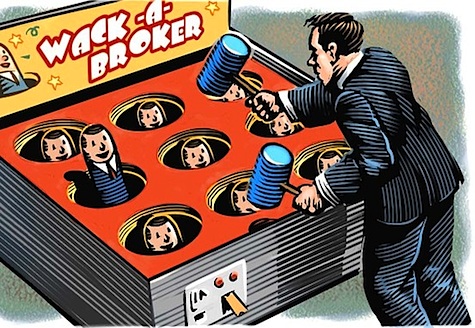
Image from wsj.com
Now let’s focus our attention on investment irregularities. Let’s take a look at some very specific and somewhat widely practiced activities that the Investopedia describes as often performed by dishonest brokers. These tactics are meant to separate investors from their money.
1. Churning Your Account
This one actually sounds like something you might be found doing on the front porch of an old dairy farm, but apparently, it’s also used by dishonest brokers. Churning involves brokers that abuse their discretionary investing authority to trade in excess, in order to boost commissions. The easiest way to prevent this is to use a discount broker, where you’re totally in charge of your own investment activities. But if you go with a full service broker and rely on someone to handle your accounts, then you should never give your express permission to your brokerage firm to do anything without your direct involvement (e.g. you have to put in an order to buy or sell before your broker can act on your behalf). Or you can also open a wrap account. This tactic allows you to only pay one flat fee no matter how many transactions are performed.
2. Steering You Away From A “BreakPoint”
A lot of brokerages charge their investors what’s known as a sales charge based on the dollar value of the investment that is made. For instance, some will charge 5% on an investment of less than $10,000 and 4% on investments $10,000 or higher. This practice isn’t uncommon. However, there may be unethical advisors who may tell you to invest $9,950 instead of $10,000 (the breakpoint), thereby preventing you from receiving a 1% savings in brokerage fees. Ultimately, this so-called advice will yield higher commissions for the brokerage. Note that your broker may also split up your investment and spread them across multiple companies, thereby racking more fees, due to the larger number of transactions.
3. Buying A Stock For The Wrong Reasons
Buying a stock quickly based on the fact that it’s getting ready to pay out a dividend is known as selling dividends. Some brokers may want to pitch this type of investment to you. First of all, buying something in a hurry, without performing proper research is never a good idea, and this is also true with investing. Basically, you’re chasing dividends: but what if your broker’s recommendation was for a weak stock? The value of your stock could go down quickly. It won’t help that the value of those recently paid dividends are subtracted from the company’s overall value. You could end up making little to nothing (maybe even lose more than a few bucks) while your broker pockets the commissions.
4. Questionable Recommendations & Advice
You may very well experience a lot of damage to your bottom line if you are unlucky enough to have an unethical broker handle your accounts. It may be as simple as giving you the wrong advice for your risk profile or your financial goals. Or they may hype up a stock that is obviously very unsuitable for your portfolio. What if they force you to concentrate all your funds into only a few investments? Or they could insist on overdiversifying your assets in order to let them achieve higher commissions from the transactions that are made. If you aren’t paying attention to what your broker is doing, they can certainly cost you quite a lot! So the lesson here is that you really should keep tabs on your investments and your broker (or advisor) no matter how well you trust them.
In most cases, an observant and astute investor will notice things going wrong well before they have to sell the farm to recoup the cash. While you probably don’t need to watch your account 24/7, you should definitely want to take a peek on a regular basis. And, don’t be afraid to ask questions. If something doesn’t make sense, don’t take your advisor’s or broker’s word for it: talk to someone else. Follow your gut and if it doesn’t feel right, then it could be time to switch brokers.
Created December 5, 2010. Updated September 9, 2012. Copyright © 2012 The Digerati Life. All Rights Reserved.

{ 8 comments… read them below or add one }
One way to avoid all these issues and the volatility of the market is to invest in mutual funds. A diversified portfolio is the best long term solution. No load mutual funds with low expenses.
Thanks for the tips on stock brokers. I have been doing a little research into shares recently and have been hard pressed to find good advice till now. Thanks. I particularly liked your point #3 Buying A Stock For The Wrong Reasons.
My view is that the problem is on one sense worse and in another sense not as bad as your moderate level of paranoia suggests, Alexis.
You’re suspicious of investment clams because the people making them are out to make a buck. Fair enough. But what if you found out that a lot of people make wildly false claims that they believe in themselves That’s a very different and potentially far more dangerous sort of problem.
The most dangerous claims out there (the claims in support of Buy-and-Hold) are not put forward solely to make a buck. The people who make those claims believe them to be true. They engage in self-deception re those claims before they make an effort to get people like you to believe in them.
Believe it not (some do, many do not), that’s my sincere take on this matter. We need to get over the idea that it is only deliberate fraud that hurts us in the investing realm. My experience is that inadvertant financial fraud is the far bigger problem, the one that today threatens to bring down our entire free market economy if we don’t soon begin to make an effort to get a handle on it.
Rob
Thanks for the post and providing us with warning signs about stock brokers. These are really great tips.
We need to get over the idea that it is only deliberate fraud that hurts us in the investing realm. I really like your post.
You may not realize just what it takes to be a broker. Those with this job are probably the most important players on the floor when it comes to buying and selling stock. We’re talking about the guy that actually gets up early in the morning to study the stock market trends on TV and the computer and in the newspaper. He’s the guy that puts on the suit and tie and goes to battle for his clients, conducting the actual transactions required to buy and sell stocks on the stock market.
So what does it take to be a broker? The brokerage firm and individual brokers have to undergo rigorous training, background checks and take a licensure test administered by the SEC or Securities and Exchange Commission. These are the guys that oversee all of the functions associated with the stock market. If you may recall, it was the SEC that got involved when AIG almost came tumbling down a few years back. They were involved with exposing Enron and MCI for the frauds they were. The SEC is the stock market police.
Okay, so back to the stock market brokers. You can think of these guys as the real estate agents of the financial world, the caddies of the stock market. These guys are an investor’s best friend and their only ticket into the fast paced world of the stock exchange. We as individual investors cannot initiate any buy or sell transactions on our own. We must act through a broker. They buy when their clients say buy and sell when their clients say sell. They provide sound advice buy and sell advice to their clients based on years of research and market trend analysis.
Great post. As a financial advisor who puts his client’s interests first, I don’t think too much can be written about this issue. It always saddens me when I read about someone who is the victim of financial fraud. What is even more frustrating is having to tell a prospective client that you really can’t help them salvage what a greedy stock broker or registered rep has done to their life savings.
Re, Churning.
Isn’t it churning when a fund does this as well?
Rick