Once you’ve gotten your debts paid off with your short term cash parked safely in a certificate of deposit or two and in high interest savings accounts, you may finally be accumulating hard-earned funds that will be better applied elsewhere and may also be wondering what to do with the savings you have that have been growing at a steady rate. So what to do? Well, if you’ve finally taken some time to reflect on your goals and life situation, done some research and gotten some questions answered; if you are set to get your feet wet in more rewarding money growth opportunities with the resources you have at the ready, then it’s time to asset allocate!
Well what is Asset Allocation exactly?
Other than being one of the more popular topics among personal finance blogs, asset allocation is the process by which an investor divides up and earmarks their money for various purposes and investments to achieve a well suited portfolio matched up to the investor’s requirements, lifestyle, goals and timeframe. Distributing your money across different asset classes based on your financial profile will yield your asset allocation, so the idea is to match the profile to the appropriate plan.
There are many asset allocation methods ranging from creating a plan for each goal you may have, all the way to just maintaining one for your current stage in life. So depending on how you’d like to do it, you may have many portfolios across different financial institutions, each geared toward a different goal such as your child’s education, a new house or retirement; or maybe if you’d like to keep with a “Keep It Simple and Sweet” theme like I do, then you’d only have one overriding plan that aligns with your age, life circumstances and investor profile.
I personally prefer to wrap up my savings and assets into one neat allocation scheme that will address my financial situation and future requirements, then keep tabs on that. What is great about performing this strategy is that it takes some of the mystery out of investing by allowing you to once more put things in automatic. If you find a portfolio type that you agree with, then your goal would simply be to ensure that your assets align with this configuration as closely as possible. Every 6 months to a year, you can check your allocation to see if it’s still as you expect and if things have changed since, you can rebalance it. I found this to be a great tool for enforcing some semblance of order and discipline to my investments, once more taking some emotion out of it! One more way you can sleep at night even if the market decides to go ballistic.
Asset Allocation Plans
Here is a table for matching up investor profiles with sample allocation plans. Note that allocations themselves (percentages allotted to various classes) may vary and are based on decisions you can make and are comfortable with.
| Investor Profile | Recommended Portfolio | Portfolio Description |
|---|---|---|
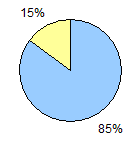
| Conservative | Stability | This is best for short term goals, where you will need the money in the next few years. Since stocks and bonds have some volatility and can fluctuate over time, it is best to keep your funds in stable vehicles such as such as money market securities, CDs, bank accounts and shorter-term bonds. |
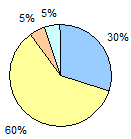
| Moderately Conservative | Income | For lower risk, go for bond and money market investments. This strategy may allow for a bit of a kick, mild though it may be; however returns may still be lukewarm and outpacing inflation is not certain. However, this may be appropriate for short to intermediate term goals, folks who shun volatility or those close to retirement. |
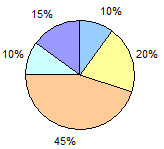
| Defensive | Moderate Income | Still somewhat conservative, this portfolio has devoted 20% to stocks and real estate, with the bulk still in bonds and cash. This combination is intended to avoid excessive volatility but has the potential to earn returns that at least keep pace with the rate of inflation. |
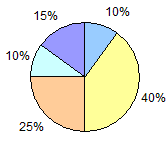
| Balanced | Balanced | With 50% allocated to higher risk investments such as stocks and real estate, this approach aims for more growth but with reasonable risk. This approach can be appropriate for retirement as well as nonretirement investors with mid- to long-term goals. |
| Moderately Aggressive | Growth and Income | With the bulk of this portfolio in stocks, you are definitely aiming for higher returns and have a stomach to ride some swings in the market. This portfolio is great for younger people and the more aggressive investor who is willing to assume relatively high risk for potentially greater returns. You will need a longer time frame to ride things out so that you don’t get tempted to bail out during changes in market conditions. |
| Aggressive | Growth | This is for investors with a lot of guts and ability to withstand temporary losses during market cycles. It has the potential to provide the highest returns relative to all other portfolios, but can surely make you squirm when things aren’t going north. The younger you are, the better this sort of portfolio is, however I recall that no matter how young I was, I never had the disposition for this type of portfolio — again it’s a matter of knowing yourself well enough to see if you have the nerves for this type of mix. |
Asset Classes
Some of the more common asset classes that comprise an allocation are:
- Money Market and Short Term Bonds, which comprise cash, checking, savings accounts, term deposits and less than one year investment grade bonds.
- Bonds, which cover investment grade bonds.
- Domestic Equities, which are stocks listed on your local market.
- International Equities covers stocks listed in or related to a foreign country.
- Real Estate / REITs includes your real estate (your main residence excluded) and stocks related to property.
Sample Portfolios
I have attempted to put together some sample allocations using the various aforementioned asset classes.

|
 |
 |

|

|
|
 |
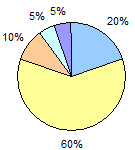 |
| Stability: Conservative | Income: Moderately Conservative | Moderate Income: Defensive |
|
 |
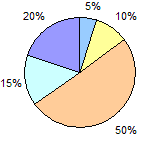 |
| Balanced: Balanced | Growth and Income: Moderately Aggressive | Growth: Aggressive |
Other possible asset classes can include among others, stocks and bonds in emerging markets, gold, commodities, currencies, penny stocks or options, but these are usually found in more sophisticated, esoteric and potentially more aggressive portfolios. More aggressive investors may need to check out commodity brokers or look into special investment platforms for their specific requirements.
What next?
Now even with setting aside these rather more challenging topics, there’s still more stuff to tackle with regards to deciding how to partition your money across the classes. For instance, with bonds, there are all sorts of bonds and bond funds to select. And with stocks, it’s easy to get confused about whether you should get into individual stocks, ETFs, mutual funds, or whether you should go for value versus growth, small versus large caps….. Ahhhh! It can all be quite much to take in one sitting. That’s something I’ll surely be tackling at another time.
In the meantime, you can bask in the knowledge that you are on your way to making your money work for you and with a better idea of where you stand as an investor, you’ll be able to identify what kind of portfolio will jive best with you. As for me, I’m a moderately aggressive investor. And how does my real portfolio stack up to the “target mix” displayed above? That’s one more thing I need to check out to see if I will have to do some rebalancing, so stay tuned for the sequel.
Disclosure: Some products or services we mention on our site have advertising relationships with us.
Copyright © 2011 The Digerati Life. All Rights Reserved.

{ 16 comments… read them below or add one }
While I understand that your goal is to maintain one strategy for all your investments, most investors could benefit from a retirement-specific strategy – particularly for employer-sponsored retirement plans like 401(k) and similar. Since 401(k) investing calls for a truly long-term mentality, I like to use more traditional asset classes:
• Highest risk asset class: International Stock Funds
• Higher risk asset class: Small/Mid-cap Stock Funds
• Medium risk asset class: Large-cap Stock Funds
• Lower risk asset class: Bond funds
• Lowest risk asset class: Short-term fixed income
And I would recommend that each retirement investor should hold funds from multiple asset classes – even the most aggressive or most conservative retirement investor is best served to diversify across asset classes.
Since 401(k) plans and other employer-sponsored retirement plans are strictly intended for retirement, and contain strong tax incentives to use them only in retirement, I worry about 401(k) portfolios, especially those of younger investors that are heavy with company stock or funds from a single asset class.
Charlie Koch, MBA, CFP®, CFS®
Investment Adviser
My take is that asset allocation does not matter all that much. What matters is your risk profile. SInce the riskiness of stocks changes with changes in valuation levels, the important thing is to CHANGE your stock allocation as needed to keep your risk profile roughly constant.
This doesn’t require frequent changes. But it makes a big difference in long-term results. Those who keep their risk profiles constant obtain far higher returns at greatly diminished risk, according to the academic research.
Rob
@Charlie, great rundown of asset classes. The way I see it — young people learn things over time. Sure, they tend to play the investment lottery a bit more when younger precisely because of their youth and the belief that they can make up for losses. They feel they can afford to gamble more. I had this mentality myself at one point 🙂 . I also remember the few times I was caught in some of the best investment bubbles we’ve seen in history. The amount of stock concentration at that time was incredible — everyone thought they’d be minting money by accumulating stock options. In the 90’s, I actually purchased a lot of my company stock options and lost tens of thousands making that gamble. It’s just one of many lessons I’ve learned since!
@Rob, I like that perspective — focus on risk profile and adjust your portfolio according to that. Right now, I’ve grown more conservative (well, for obvious reasons). Kids are going to need college tuition money. I am no longer a spring chicken 😉 . Need to save for health requirements as we age. So no surprise I’m now almost at a 50%/50% in terms of equities and fixed income. What’s your portfolio like? I’d love to hear about it. Would you like to guest post and write about your own asset allocation and portfolio? 🙂
When I was young I would check my stocks almost daily or at least weekly. I still keep tabs on my stocks weekly but my assets I review once per quarter and realign once per year.
Great article. On Rob’s point…..I’m confused….isn’t your asset allocation based on your risk profile? So basically by paying attention to your age and years to retirement (decreasing risk profile), that will direct your asset allocation (to increased bonds as you get older). So paying attention to risk profile is same as paying attention to asset allocation, indirectly?
Maybe I’m not understanding when he says “risk profile” because changing your stock allocation will reduce/increase your risk profile depending on if you decrease/increase your stock exposure, not keep your risk profile constant, right? Yes greater risk profile leads to greater return profile, but not necessarily at reduced risk (if we’re talking risk in terms of volatility or standard deviation).
Curious…
thank you in advance!
Would you like to guest post and write about your own asset allocation and portfolio?
Thanks much for that kind offer, SVB. That’s like putting catnip before a crazy cat! There’s nothing I love more than opportunities to get these ideas out before more people.
I’ll send something your way by the end of the week.
Rob
isn’t your asset allocation based on your risk profile?
I fully appreciate your confusion, Kathryn. You are in excellent company. There are many good and smart people who are not able to make sense of the approach I recommend. I’ll make an effort to address that in the Guest Blog I will be putting together for SVB.
The cause of the confusion is that there are two entirely different models for understanding how stock investing works. The dominant approach today is the Buy-and-Hold Model — that’s the one you are describing. I believe in the model developed by Yale Economics Professor Robert Shiller (the subtitle of his book <Irrational Exubrance describes it as “The National Bestseller That Revolutionized the Way We Think About the Stock Market”). The two models are rooted in opposite premises and support entirely different strategic choices re just about every aspect of stock investing –retirement planning, asset allocation, risk management, everything.
You are properly describing how the Buy-and-Hold Model works. You decide on your stock allocation by taking your risk tolerance into consideration. Then, whatever asset allocation you come up with, you stick with it.
Things are done differently under the Shiller Model (I call this “Valuation-Informed Indexing”). The belief here is that stocks are far more dangerous at times when they are insanely overpriced than they are at times when they are low-priced or fairly priced. Say that you possess an average risk tolerance. A 90 percent stock allocation might be right for you at times of low prices because there has never in history been a time when stocks have performed poorly in the long term starting from a time of low prices; a 90 percent allocation makes sense at a time when the risk of investing in stocks is just about nil. But you wouldn’t want to go with a stock allocation of more than 30 percent at times of super-high prices because there has never yet been a time when stocks have offered good long-term returns starting from a time of super-high prices. There’s more risk in going with a 30 percent stock allocation when prices are high than there is in going with a 90 percent stock allocation when prices are low.
There is academic research showing that changing your stock allocation for the purpose of keeping your risk profile roughly constant ALWAYS works; there has never in 140 years been a time when doing this did not produce far higher returns at greatly diminished risk. Consider recent history. Prices were rock-bottom low in 1982. Stocks provided the best returns they have ever provided in the following 18 years. Prices were the highest we have ever seen in 2000. Returns from 2000 forward have been poor.
This is not short-term timing. Valuation-Informed Indexers agree with Buy-and-Holders that short-term timing never works (there is research showing this). The disagreement is over long-term timing (changing your stock allocation in response to big price swings with the understanding that you may not see benefits for doing so for as long as 10 years). The same data that shows that short-term timing never works also shows that long-term timing always works. So Valuation-Informed Indexers practice long-term timing but not short-term timing.
Rob
@Rob, haha! I like the catnip analogy. I am hoping you can actually show us your portfolio and picks. What it is you have on your end and why you’ve done it that way. Now I know lots of people have other ideas about how to build portfolios and so forth. But I am always curious as to why people put together their portfolios a certain way. Some investors I know like to pick stocks while others do it with pure index funds or actively managed funds or pure ETFs.
Now I know this kind of stuff sparks religious debates. It’s happened here before and elsewhere. But I am one who wants to learn and digest the different theories and then assess/decide for myself which way I’d like to go. I listen to all arguments and then make an informed decision based on my comfort level.
From what I gather, there are many ways to look at things and sometimes, we are really talking about the same things, just in different ways. At other times, there are techniques that resonate better with us than do other strategies. But from my own experience, I can’t convince the successful stock picker that they should stick to index funds — they just won’t go this route. It’s really all a personal choice about how you interpret investment research and theory and how well it sits with you (while truly understanding your psychological makeup, risk profile and financial requirements for the future).
Btw, long term timing — that was something I remember being brought up when I used to follow Bob Brinker on the radio. There is risk when you make timing choices though, right? Bob Brinker made long term timing calls and he didn’t do well when the bear market hit since he was a long-standing bull. In general, I am most comfortable with the asset allocation/diversified/hedging model (I engage in some timing and in more esoteric investments in a small portion of my portfolio just to get the extra kick) as a core approach though, to be more systematic about things. There’s less buy and hold here, since you’d be rebalancing to keep with the risk/return model you are trying to maintain.
I have read dozens of personal finance books, blogs, newsletters, and articles about asset allocation. I have never gotten a good answer to this question: Why should I have two thirds or more of my stock allocation in domestic stocks and one third or less in international stock when the US economy only makes up 25% of the world economy by GDP. Isn’t there risk in putting a disproportionate share of my wealth eggs in the US economy basket? Do investors in Europe have two thirds of their money in US stocks? How about those in China? If the basis of your investment strategy is to diversify, buy, and hold, why would you allocate so much wealth to one country when over the long run that country may not perform as well as the world economy as a whole?
@James,
I address your question here, in my post on the optimal foreign investment allocation. Again, it all goes back to risk perception and correlations. As you will read in my post on foreign allocations, everyone has their own comfort level as far as how much to allocate per asset class. I provided an argument as to what allocation amount/percentage has been deemed ‘optimal’ according to studies made on past data (but we know that historical data can only go so far), but each person makes their own decisions as to what they’d like to do with their portfolios. I personally go by the 30% foreign basket, while others go for a bigger representation in international equities. To each his/her own. But it’s worth it to make sure you have the right data to go by, in order to support your personal decisions.
Something to note though, that studies also shift based on new historical data that is generated over time (it’s all a moving target, really). And you make a great point that when the investment environment changes, so should we, as nimble investors, change our orientations to align with those changes.
@Rob, I see what you’re saying now, thank you. Actually, this makes complete sense to me. Can this theory be applied to the bond market as well? I ask because anyone on the brink of retiring who is holding a significant amount in bonds might have some problems. If we ignore traditional asset allocation (by age), and instead focus on valuations as you say, they could be saved from getting the short end of the stick of the bond bubble bursting right before they retire, assuming they’re heavily tilted to bonds now. Just wondering because I know several people in their late 50’s who have zero invested in bonds (treasuries) right now for that reason.
Can this theory be applied to the bond market as well?
Valuations certainly need to be considered in purchases of all investment classes, Kathryn.
However, valuations don’t offer nearly the same power to predict returns with investment classes other than broad index funds. The magic of index funds is that everything except overvaluation or undervaluation is included in the price (mispricing of course can by definition never be included in the price). So with index funds, that one factor tells you all you need to know (within reasonable limits) the return you will obtain in advance.
With bonds, for example, you would need to know the future inflation rate in order to figure out your long-term return in advance. With index funds, you can assume that the long-term average return will be something in the neighborhood of 6.5 percent real because that number has applied for as far back as we have records. That’s an inflation-adjusted number, so inflation is not something you need to worry about separately.
I certainly agree that people investing in bonds today need to be concerned about valuations. The caveat I am adding is that the opportunity to make use of valuations in making effective purchases of index funds is more enticing. You need to consider valuations as a defensive move re other asset classes. With index funds, you can use valuations both defensively (to avoid losses) and offensively (to know when to buy index funds to lock in amazing long-term returns).
I hope that makes some sense (please understand that I am NOT an expert in this field, just a journalist who follows this stuff and reports on what I learn).
Rob
With AA there is nothing written is stone on how to diversify your assets. Each person must know their own risk and 2008 was a prime example. I think John Bogle’s rule of thumb to follow is your age in bonds. At worst I would listen to the master. I am 52 and am approximately only 25-35% in stocks for personal reasons.
@Rob I really appreciate your thoughts on this, it’s all so interesting to me. Thank you so much, and to the DL for providing the great discussion.
Thank you all! I will be featuring more of Rob’s sentiments shortly in a guest post. He always has some thoughtful insights. I have found the long term timing idea intriguing because I used to follow Bob Brinker (a radio investment guy). But his long term bullish model went awry after the bear market of 2008 hit. I think it may be because he was a long standing bull and well, a broken clock can still be right twice a day? I believe in the value of applying valuation assessment to investing though, although I tend to manage investments in a more automated/passive way in general (and work on any timing decisions with a newly hired professional investment manager to help manage things with me).
Thank you for this very informative article.
I just recently invested my money, with all my assets allocated in a Norwegian portfolio with a rather aggressive profile. My plan is to let my investment simmer for 19 years, with the annual checkup of course. I think 15-20 years is sufficient for an aggressive profile, as the market will have a downfall every 4-7 years. I just need to remember to check in at least once a year in order to determine whether my investment is best left for about 5 years more (depending on how many years are left in my scheduled plan), or if I should ‘cash in’ my portfolio before the arrows start turning south.
Thanks again.