National health care is a highly charged but popular topic of discussion but a lot of people were worried about health insurance long before the hype. Even Obama’s Health Plan (ObamaCare) continues to have everyone talking. In 2007, a significant 17.1 percent of Americans were uninsured. That’s almost 50 million Americans who lack any type of health insurance coverage. Sadly, almost 20% of those people are children.
Who Is Uninsured?
Lack of health insurance is a problem for people from all walks of life. Most states have programs for children and elderly to receive some type of coverage. As a result, a large number of those who are uninsured are also of working age, with many working hard with no health insurance to help them when they are ill or in pain. As you can expect, those who earn less are more likely to be uninsured. Note that more than a third of families with an income below $10,000 annually are uninsured, as compared to 7 percent of families with an income over $75,000 who are annually uninsured.
In other words, having a job does not mean you’ll necessarily receive health insurance. About a quarter of uninsured workers are employed by firms with more than 500 employees! Employers are not required to provide health insurance for their employees despite the fact that health care costs and spending in the United States have soared at an average rate of 10 percent a year since the 1960s. It is estimated that 18,000 to 22,000 Americans die annually due to lack of health coverage. Costs continue to rise as people remain uninsured, creating the crisis we have in the country today. [Source: CoverTheUninsured.com]
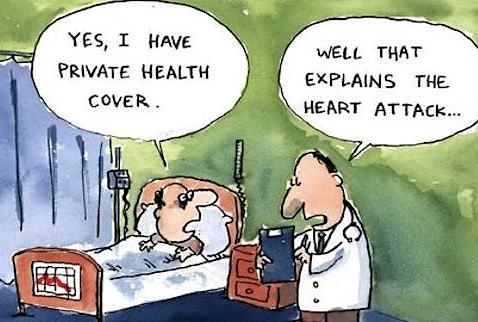
Illustration by Jon Kudelka
What Is The ObamaCare Plan?
Obama states about the proposed plan:
“It will provide more security and stability to those who have health insurance. It will provided insurance to those who don’t. And it will lower the cost of health care for our families, our businesses and our government.”
For those with health insurance, the plan proposes to end discrimination against those with pre-existing conditions, limit premium discrimination based on age and gender, prevent people from being dropped when they need insurance most, cap expenses, eliminate extra charges for routine tests and shots, eliminate gaps in coverage for prescription drugs and protect Medicare for seniors.
If you have no insurance, the plan intends to create a new insurance marketplace called the National Health Insurance Exchange, where people can compare plans and buy insurance. Tax credits will help people and small businesses buy insurance. There will be a public health insurance option for those who cannot find affordable insurance and a “high risk” pool will be created to provide low cost coverage for people with preexisting conditions. Large employers will be required to cover individuals and families who can afford to purchase insurance.
No Health Insurance? Options for the Uninsured
While government power players negotiate our health care future, people need solutions now. So what options are available for those who are uninsured today?
COBRA
For those who were involuntarily terminated from their employment between September 1, 2008, and December 31,2009, you may qualify for subsidies to cover 65 percent of the cost of health insurance premiums paid under COBRA. This state program allows you to continue coverage provided by an employer, by letting you pay the premiums for up to 18 months. The economic stimulus package pays subsidies for individuals with incomes up to $125,000 and families with incomes up to $250,000.
Tricare, CHAMPVA
Tricare was formerly known as CHAMPUS. This program is administered by the Department of Defense for military retirees, families of active duty, retired and deceased service members. Disabled dependents of veterans and certain survivors obtain coverage through CHAMPVA, the Civilian Health and Medical Program for the Department of Veterans Affairs. More service providers were recently added. CHAMPVA patients can elect to receive treatment at VA medical centers to avoid the 20 percent co-pay for private physicians.
Medicaid and Medicare
Medicaid is a health and medical services program that offers coverage for those with few resources and low incomes. While the federal government oversees the Medicaid program, the criteria is determined by each state. Another option includes low cost clinics, which exist in many counties across the nation. Medical care is rendered based on need and income, with patients paying as little as $15 per visit.
Medicare pays for hospital and medical care for elderly and disabled Americans. It’s divided into parts as follows: hospital and medical insurance are Part A and Part B while flexibility and prescription drugs are addressed by Part C and Part D. With Part D, pricing pays for 75 to 95 percent of prescription drug costs. To be eligible for Medicare, you must fall under one of the following categories: (1) at least 65 years old, (2) under 65 and disabled, (3) or any age with permanent kidney failure requiring dialysis or transplant. You must be a U.S. Citizen or permanent legal resident for at least 5 continuous years.
Both Medicaid and Medicare are managed by the Centers for Medicare and Medicaid services, which is a division of the United States Department of Health and Human Services.
Medical Discount Plans
There are hundreds of discount medical plans available offering you anywhere from 20 percent to 70 percent of the cost of routine visits and treatments. These plans are not considered health insurance and often leave gaps which people cannot afford to cover. Meanwhile, you are still paying premiums for this minimal coverage. It is advisable to participate in health insurance rather than these fly-by-night medical discount plans.
To find out more about health insurance coverage available in your state, visit CoverTheUninsured.org to get the latest facts. With millions of people uninsured today, we can’t wait for tomorrow to get coverage!
Copyright © 2010 The Digerati Life. All Rights Reserved.

{ 18 comments… read them below or add one }
Another thing that I am starting to see more and more of today is that employers are hiring more part-time workers (30 hours a week) in order to save on the cost of paying the benefits for the employee. It’s a tough time! Thanks for posting about some solutions.
Hiring part time workers, certainly saves the employers a lot of money, which they should have paid towards insurance premium and other fringe benefits. All this is setting a bad precedent, and should be stopped. The organizations with a threshold limit on the number of employees (whether full time or part time), should compulsorily be made to contribute towards the welfare schemes for their employees.
My sil just got out of the Marines. The COBRA for departing members is a mere $1996. per three months for a family of three. Is that even close to reasonable? Once they are done with me paying the first three months- they will go to Medicaid while they attend school. Wouldn’t it be more reasonable to cover more of the COBRA costs and have them put in some? Health care is outrageous!
Thanks for the post!
I really can’t tell by the tone of your article if you support Obama Care. I can tell you unequivocally, that the program will not either decrease costs or improve care, It will both increase costs, through tax payer burden, and it will pull incentive away from providing quality care, while chasing most carriers out of the marketplace, leading to nationalized medicine, which has not worked well anywhere. Just look at medicare, and the VA, is the government doing a good job with health care? We need to open our eyes, America. Thanks for the post!!
Your statistic that 22,000 Americans die each year because of inadequate health care coverage is alarming. But it is insignificant compared to the 2,778,000 Americans that die each year with health care. What are we going to do about that problem?
Oh, one more thing. Maybe those without health insurance are lucky since “Perhaps more surprisingly, a stunning 178,000 Americans die from medical or hospital error every year.” Maybe we all would be better off if we took care of ourselves and not go to doctors.
Yes, doctors and modern medicine won’t be able to cure every ailment out there. In fact, lots of patients slip through the cracks even when they’re treated with the most advanced medical help available. With health care here, you improve your chances of surviving, living and getting well. But there are never any guarantees.
Yes, there are two guarantees: death and taxes. While I cant do anything about death I can do something about taxes. Especially taxes that pay for a health care program with no guarantees.
My mother died of cancer not too long ago. At the time one would think that if we just threw money at the problem and/or prayed enough she would have lived. In retrospect, what difference would it have made? The six months of agony we went thru while she died would have been repeated years later. There is no escaping death and when society realizes this they may come to their senses and place a more realistic value and expectation on health care. The government isn’t going to save us from death nor taxes.
Must be a bunch of greedy republicans.
When are people going to learn you can decide when you are going to get sick.
@Jack
Do you mean “you can’t decide when you are going to get sick”? This is a sticky topic. Health care here is a mess. I think a lot has to do with the insurance industry being the way it is. You take them out of the formula and things would get cheaper.
Yes, Yes, Yes.
Get rid of the insurance companies and things would get cheaper.
Yes, Yes, Yes.
I have been saying this for decades but few understand. That’s exactly why I don’t think the government should get in the insurance business. The recent health care bill was more about the govt become an insurance provider rather than a health care giver. I wish the politicians would read AND understand the bills they vote on.
I am also uninsured and I have been saving money by purchasing medications online at International Drug Mart. I have been using their coupons to save money.
The Coupons Used at International Drug mart were 15C2G, 15CNP and 15HAN – with this coupons you can avail $10 discount when you order above $70 and 10% discount when you order less than $70.
I have been on the fence about canceling my $1300.00 pr month health insurance for the past year. Does it make sense to go to self pay? – which is much cheaper for all the medical care than having insurance and I get to put the premiums in the bank. I have a friend who works in a hospital and he said to cancel, go to self pay and wait till something happens, then pay the bill for the initial visit, then go get health insurance to take care of the rest of the expences for that particular illness. The health insurance companies can no longer deny anyone for pre-existing conditions. Sounds good but I’m still stuck in that old fashioned mind-set (you must have health insurance!) Does anyone do this??? What do you think???
Wrong J , you will be turned down if you’re sick. People with pre-existing conditions aren’t able to get benefits.
I am one of those stupid greedy conservatives, but recently changed my mind on health care rights. Yep, it is or should be a right. We live in a country that expects you to keep your dog fat and healthy! Yep, we might as well face it. I think the Universal Health care with all paying…rich and poor can get health care via flat tax. Won’t happen until we decide it is a right. (It is a right, if it is you, in this situation).
I was surprised to see that the 22,000 deaths a year due to inadequate insurance has been readjusted (and is an underestimation). In actuality, the latest numbers now show that 45,000 deaths are tied to the lack of health insurance. Really a very sad matter that needs to be addressed and resolved. Can we put our focus on reforms in the health insurance industry?
I don’t have insurance as well, and I have been getting medications online to save money. I think that Part D insurance is a doughnut hole. To me, with insurance or with out insurance, it doesn’t matter. The International Drug Mart has been a god send to me. I have been getting generics and that is how I have been saving.
I have a small business with my husband. We pay $800 a month for insurance that basically covers nothing (end up paying $300 plus after exams, etc.). I have never been without insurance which makes it kind of hard to pull the plug and go self-insured but it seems to make sense as we are both healthy-ish.
Does anyone know how to find more information on becoming self insured for a small business? Do you just cancel the current policy or does it involve red tape regarding the State of California, IRS, etc???