So you’ve opened an account with a stock broker. What’s next?
Some say that we should spread our eggs across many baskets. Some say that we should put all our eggs in just one basket… and watch it carefully. So which is the best advice?
Unless you have the luxury of being able to watch a single stock position like a hawk, or have your automated stop order watch it for you, the first piece of advice is the one you should take notice of.
Put your eggs in many baskets!
In a nutshell, here’s what diversification stands for:
It’s a portfolio strategy in which you spread your money around among different investments in order to reduce the risk of loss from a decline in the investments. Its goal is to reduce the risk in a portfolio. When diversification is properly applied, then it is expected that volatility or fluctuations in portfolio value become subdued and limited. The act of diversification reduces a portfolio’s swings as well as both upside and downside potential, thus — and I like this statement — allowing for more consistent performance under a wide range of economic conditions.
That said, I’d like to list the different ways you can actually diversify to control that so-called market risk:
Different Diversification Strategies For Your Portfolio
#1 Diversify across asset classes.
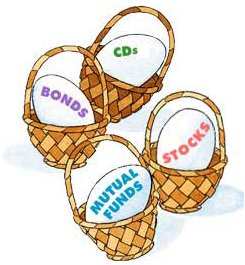
Remember that it may not be enough to hold separate positions in different stock indexes. Why? Because many of those indexes may tend to rise and fall at the same time, which is why it’s a good idea to throw a lot more asset classes such as some commodities, bonds, property and cash, and other assets into the mix. Therefore, the most common way to diversify is according to asset classes. When you employ an asset allocation strategy, you are controlling the level of risk that your money is exposed to since your funds are spread around across different forms of equities, bonds, cash and hard assets.
Some common asset classes include:
* equities
* government bonds
* corporate bonds
* cash equivalents
* real estate
* currencies
* gold
You can easily achieve diversification this way through mutual funds, index funds and target date funds.
#2 Diversify across asset class variants.
Within each asset class, you can practice further diversification. For instance, equities have many representations in the mutual fund world. Variants or subclasses refer to more granular characteristics of the asset class. Here are some examples:
Equities can vary according to:
* the size of companies represented in a “basket” (e.g. large vs medium vs small cap stocks)
* the way the stocks’ prices move as the stocks chart their growth (e.g. growth vs value stocks)
* the geographical market in which the stock moves (e.g. domestic vs international)Bonds can vary according to:
* their maturity dates (e.g. short term vs long term bonds)
* their level of risk (e.g. junk bonds, anyone?)
* who issues the bond (e.g. government vs corporate)
* how they pay outCash vehicles vary mostly according to rates of return and level of security offered, which are usually characteristics that are inversely proportional to each other. Generally, within the investment world, the higher the rate of return, the less stable the fund value is expected to be.
Note though that most of the time, you don’t really need to seek this kind of detailed representation to achieve a well diversified portfolio, as positions in basic asset classes may be sufficient to lower your market risks.
#3 Diversify across securities or investments within each asset class
If you are buying mutual fund shares, then you are effectively diversifying across securities. By buying into a basket of securities via index funds, mutual funds, ETFs, managed funds and such, then you are automatically spreading your risk across the board.
#4 Diversify across industries and sectors.
If you are interested in following a particular sector or industry but do not want to put all your eggs into one company’s stock, you can buy sector funds that specialize in a specific industry or stock group, such as financial stocks, gaming stocks, internet stocks, semi-conductor stocks and the like. You’re diversified within a group, but still fairly concentrated within a sector.
#5 Diversify across financial institutions and fund families.
There are many financial institutions and companies out there, from discount brokers to mutual fund companies, banks and even insurance companies — all offering financial and investment products. But no institution is perfect. Your non-cash investments are not FDIC insured, so entrusting them to any one institution holds some risk, no matter how minuscule. Banks and institutions have folded in the past, and have been rocked by scandal on occasion. So it’s something to keep in mind when you’re putting your money on the line. There’s a tradeoff between desiring the convenience and organization of a consolidated portfolio in one location versus deploying your funds across various companies, or placing your eggs among various financial baskets on the Kiplinger’s list of “favorite fund companies to buy into now”.
#6 Diversify across fund managers.
Again, when you invest in various mutual funds, you are normally giving your money to different fund managers to invest. But it’s not all too uncommon for the same people to be simultaneously heading multiple funds, as in the case of the same managers used for various international or foreign based funds in the same institution.
#7 Diversify across time horizons and levels of liquidity.
Based on your various goals, it’s a good idea to maintain different levels of liquidity. For your short term goals such as funding a big ticket event (e.g. wedding or travel), you’re typically going to save using a cash account. For medium term goals, you can take some risk with blended funds for example, while for the longer term goals (e.g. kids’ college fund, retirement) you can be less liquid, by getting into more aggressive stocks or real estate.
#8 Diversify across time with dollar cost averaging (DCA).
When do most people decide to throw a lot of money into the stock market? Is it when it’s the best time to do so — for example, in March 2009 when the market was scraping the floor? No, it’s when they find themselves with a large cash pile from an unexpected inheritance, severance package or house sale.
Suppose you had received your windfall payment in October 2007 and had ploughed it straight into the S&P index fund all at once, just as the advisor advised. Could you have sat tight through the 55% fall without selling out at exactly the wrong time just before the inevitable recovery began?
It is for this reason that some financial advisors suggest pumping your funds into the markets gradually over time using the process known as dollar-cost-averaging; the idea being to lessen the potential effect of sheer bad timing.
Dollar cost averaging means investing a same-sized amount each month, let’s say $500 per month, on the basis that this fixed installment buys you more fund units or equity shares when the price is low and fewer when the price is high. So you don’t have to time it right. Dollar cost averaging is a form of diversification over time.
One of my favorite diversification mechanisms is by investing periodically across time. By buying stocks on a regular basis, you end up picking up stocks at a variety of prices as they fluctuate. In this case, if you’re not confident about the market’s movements, you may want to distribute your purchasing power throughout a specific time period.
But be aware that some financial advisors recommend this approach in order to secure a regular commitment from those clients who simply don’t have a lump sum to invest at the outset. Also, we should note that there have been strong arguments that investing a lump sum in one fell swoop actually results in better returns compared to a DCA strategy. Historically, with markets marching higher, it turns out that you may be sacrificing a bit of your returns for that sense of “security” or assurance that you’re not buying all at once at the “wrong time”.
In Conclusion
Asset allocation accounts for 90% of your return while individual securities and market timing will account for the other 10%. By diversifying, you can reduce risk for up to 70% of the total risk received by a non-diversified portfolio or pure/concentrated position. So take precautions and practice reasonably diversified investing!
Created June 1, 2007. Updated October 31, 2011. Copyright © 2011 The Digerati Life. All Rights Reserved.

{ 9 comments… read them below or add one }
You could also just select index funds that track the components of a broad market index such as the S&P, which is already highly diversified. By doing that, you avoid the fees of a heavily managed mutual fund and the time/expense of trying to create a diversified portfolio yourself. A good diversification strategy is to invest in true low-cost funds that are diversified through as many industry segments as possible among domestic, international and liquid real estate markets (REITs).
It’s harder to achieve true diversification. It looks like the S & P is much more in tune with the performance of other benchmarks, particularly those in emerging markets and even in hedge funds. It has been said that the correlation coefficient that was developed to measure how closely related markets are (in terms of how they move), is now at its highest points.
For instance, the Reuters/Jefferies CRB Index and the S & P correlation has gone up recently, and so has crude oil + developing countries + the S & P.
You know what has a really low correlation to all these investments? Try U.S. farmland!
Well you can also try to buy mutual funds which perform well. Invest in one after looking at its portfolio and try to mix your investment well within the sector as well as in other markets, like govt securities etc.
Here’s my take on this:
Let’s diversify our holdings, as you’ve suggested. So you have a lump sum to invest, and the financial advisor recommends that you diversify by buying into an S&P 500 fund or Exchange Traded Fund (ETF). Your eggs are now spread across 500 different baskets; or are they? The fact is that you must buy this S&P 500 in its entirety and sell it in its entirety, with no ability to selectively buy and sell the individual constituents. In a sense, all your eggs are in one basket.
If the S&P index falls, the value of your portfolio falls regardless of the relative performances of the individual stocks. If the index is perfectly diversified – as you might hope – then it will go precisely nowhere, because each falling stock will be offset exactly by a compensating rising stock. That’s not the case, of course, and over time the major stock indices do tend to rise. If you don’t sell out at exactly the wrong time during the next financial crisis, and you just keep holding through thick and thin, you should hopefully benefit from the well-documented historic returns from the ever-rising index.
This is a good starting point for wealth preservation, better than staking the whole farm on just one tipped stock, but it’s not enough. And it’s no way to get rich if you are not already rich.
In order to go from zero to hero you would need some ability to back the winners and ditch the losers by buying and selling truly independent stock positions. It turns out that this finer-grained diversification across entirely separate independent holdings is also less risky than a single index holding.
The bottom line is that a single holding of anything, even a supposedly diversified stock index, does not provide sufficient diversification. We must diversify across holdings.
Thanks for all your comments! I wanted to related this little ditty about diversification — it made an impact on me. 🙂
In the early 90’s, I worked at a software company that was still in the early stages of growth. Little did I know it would turn out to be one of the most successful companies in the tech industry today, responsible for keeping countless IT departments running around the globe. At any rate, I remember one day as I sat in one of our then moderately sized company town hall meetings when one of the very irascible yet popular vice presidents of the time was asked a question by the curious masses from the lower ranks.
At that time I did not know what that word meant. I was in my early 20’s and still trying to get my arms around my new job out of college. I just thought, heck that’s a big word, I need to look that up. Today, I look back at that point in time when I first heard of “diversification” and appreciate it so much better. It only takes a few market crashes and single stock wipeouts before it starts to grow on you.
Thanks for this post. I’m diversified due to ADHD investing, but it’s good to put some real information behind how to diversify. Can you put up a post on over diversifying?
@Her Every Cent Counts,
I will have that article for you on diversification problems at some point. It’s in the works! I also tended to invest rather haphazardly some time ago but have been much more careful since. It may be a good idea to consolidate and work on a cohesive portfolio to get better mileage from your positions. I am an advocate for simple portfolios.
All great points to consider but I would like to add one. OVER DIVERSIFICATION can be a serious mistake. If you diversify to the point of becoming a mirror of the market you might as well own a couple of index funds and settle for market returns and risk. I have written an article titled “Are Your Investment Returns Suffering From Over Diversification” for anyone interested.
Great article and nice point on “over diversification”, Ken. Another trap: a lot of times we assume that we are diversifying our portfolio if we choose two or more mutual funds in the same general market-eg. a “US Growth Fund” and a “Global Growth Fund” but this needn’t be the case because the managers in those funds may be investing in a lot of the SAME companies — GE, AAPL, GOOG and so on — because they may want to own those brands which are both American and Global. This is investment “overlap” and it is prudent to check for this via reports from Morningstar etc. and choose funds accordingly. Diversifying by asset class is a lot safer and here’s the case for gold as an investment and asset class: Why Invest In Gold?.