Real estate depends on location. But even a nice location can have a problem.
Sometimes, when driving around suburbia on our way to visit friends or family, we take the Bay Area back roads. At times, we find ourselves lost in the elegant settings of some of the ritziest neighborhoods in Silicon Valley, those which harbor some of the more affluent postal codes in the nation. We go this route to admire and enjoy the scenery and the residences. During our meanderings, we’ve noticed that not everybody with a tony address and a big house may be in as good a shape as you would expect.
So what do you do when there’s a creepy old house located next to you or even down your street? Nobody is immune to such a blight. It looks like no matter where you live, you’re susceptible to some things that could be out of your control.
When I see places like these, I curiously think about its history and try to imagine what’s happened. It becomes particularly mysterious when a place on majestic grounds suddenly takes on an intimidating appearance. Why would such a place become abandoned? Maybe the people who live there are in financial trouble or embroiled in legal problems. Maybe they’re too old to maintain their surroundings or too old to care. They could be in foreclosure or liquidating because of a divorce. Maybe it’s a home stuck in limbo while its owners fight bureaucracy over how to rework or attend to the property.
In some parts of the SF Bay Area, this is what you’ll see. This is what an abandoned house in Atherton, California looks like:
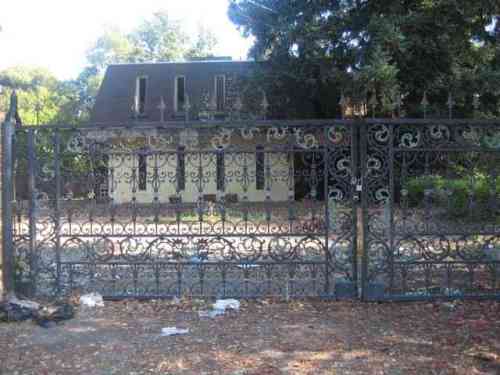
|
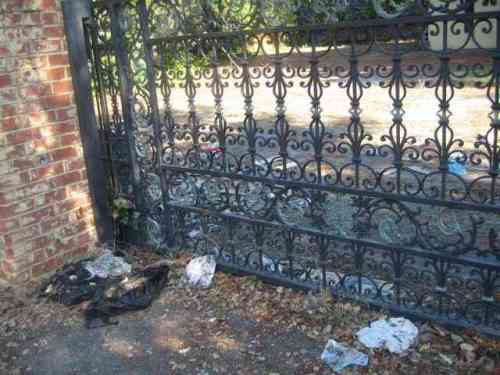
|
Whereas this is what’s usually the norm for problem houses anywhere else (Image Credit: Elephant Rocks):
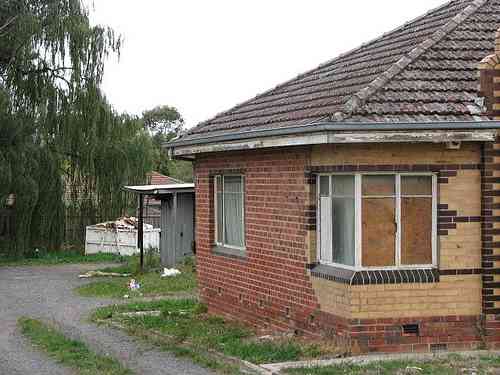
If I ever see a house like this around where I live, I’ll be asking tough questions like:
#1 Why don’t these people sell their property?
#2 Who wants to have a neighbor who can be harboring vagrants? Or criminals?
#3 Can we make sure this doesn’t become a fire hazard or a health concern?
#4 Will this bring down the price of my real estate?
What practical things can we do to avoid having to live beside a “problematic” house? It may not just be about old empty structures. It could also be about a house that doesn’t follow zoning standards (and may seemingly be getting away with it) and which sticks out like a sore thumb.
10 Tips To A Nuisance Free Zone
#1 Do a careful review of your neighborhood.
You won’t have any problems next door if you don’t put yourself in that position in the first place! Many of these issues can be avoided altogether if you check out the vicinity of your home prior to committing to it. Before you buy or move into a new neighborhood, diligently check out your surroundings. Don’t rush into that contract or long term lease. I remember how our real estate agent warned us that a pretty house on a lovely block with a decent zip code shouldn’t be the only thing to consider when making such a life altering purchase involving your permanent place of residence. See if you can find out something about the neighbors you’ll have. Are these people nice or do they have loud pets or even louder motorbikes, tools or other equipment that go off in the middle of the night?
#2 Live in a community that provides its own services for a fee.
This may not be something many people would prefer, as you’d be subject to a monthly outlay this way. But if you want to make sure you live in a well maintained community, go for one with a Homeowner’s Association (HOA) that enforces rules and standards over its homes, at least from the outside.
#3 Live in a neighborhood with stringent regulations about how homes should be maintained.
As in the case of HOA communities, by choosing to live in a planned community or one with stricter zoning laws surrounding the maintenance of the homes in it, you may protect yourself from some issues that would plague others in more unregulated locations.
#4 If you’ve got a problem, find out information about the property in question.
Say it’s too late and you’ve already moved into your dream home only to realize there’s something amiss nearby. What then? You can either live with it, or understand what’s going on. Find out a bit about the property, especially if it’s abandoned and growing weeds. It may pay to know who’s behind the eyesore: it’s a first step to addressing this issue. A service such as the once highly hyped but now defunct RottenNeighbor.com could be helpful.
#5 Communicate with your neighbor.
If your neighbor’s actually on the site and appears harmless, then striking up a conversation with them may reveal facts that can either appease you or aggravate you further. Again, it could be the first step to action. Unfortunately, it could also be dicey to ask them to get their act together in so many words. If you’re going to try, you could at least be as diplomatic as possible as I found that a pleasant approach gets much more traction than a negative or threatening one.
#6 Get other neighbors involved.
This can be handled several ways: attend town hall meetings, village or neighborhood get togethers that allow the airing of this type of problem. Zoning issues and other conflicts are typically brought up in forums like this. On the other hand, you could hold a friendly neighborhood barbecue and pick the minds of everyone who attends. Someone may have the inside scoop on the problem.
#7 Form and join a neighborhood watch group.
I know this could be merely a band-aid to address deeper issues but it allows for an organized group to keep an eye on their community and especially on certain locations that may be vulnerable to unwanted visitors. It could help with preventing drifters or worse — criminals — from loitering around areas of concern.
#8 File a formal complaint to the zoning board or inspections department of the community, county or city you live in. As one of your final options, you can declare a problem house a public nuisance. I’ve seen this work pretty well in the past, with a fair measure of success. Be patient, since it does take some time for investigations to be handled.
#9 Contact your fire marshall, board of health or other authorities who may be able to assist your case. If there is a potential health hazard around your area, this could trigger quicker resolutions once it is reported. Capture the evidence and bring it up to the appropriate personnel.
#10 Move.
As your true last resort, consider selling your house and moving elsewhere. However, depending on the size of your quandary or how near you are to the property (or properties) of contempt, your home’s value can be sorely affected. So taking this step is a big one with potential financial consequences. I’d consider this a desperate measure. Now if you’re renting, life will be so much easier for you as moving will be the easiest way out!
If you do happen to have this kind of house up your street, what would you do? As a kid, I’d be conjuring scary stories about it with my friends while watching more adventurous types gingerly explore its perimeter. As an adult, I’d be thinking about the bottom line and what this is doing to real estate property values. That and praying that the empty house gets sold really quickly!
Update: Well, some prayers must’ve been answered. That old house in Atherton, CA that stood empty for at least a year is no longer “abandoned”. It has been razed to the ground and is now for sale as an empty lot. Their neighbors may now rejoice.
Created June 14, 2007. Updated September 7, 2011. Copyright © 2011 The Digerati Life. All Rights Reserved.

{ 11 comments… read them below or add one }
you can also get your community together to get the town council to pass property ordinances for maintaining houses. that is what happened in my parents’ neighborhood (non-gated, non-planned community).
Keep in mind that HOA’s usually charge fees. So they may not be the most cost effective way to do this. Most cities though have ordinances against this sort of thing. Go to your local city clerk and file a complaint. Then show up at the planning commission meeting and make yourself heard.
We often forget how much impact city government has on us but for day to day stuff like this, it can really help resolve problems.
Gal
I’ve always tried to buy the ugly/abandoned house down the street. Done this about 4 times and made a profit at it.
Someone just told me they wouldn’t bother their neighbor no matter how problematic their home happens to be. I’d like to ask — when does a derelict home or seemingly unoccupied and ill-maintained piece of property stop becoming none of your business and start becoming a neighborhood problem?
The point is that you can do something to help resolve things as has also been pointed out here in the comments.
I have one point to raise here after reading this article: People, as a general rule, do not have the outgoing nature and/or tact to just meet their neighbor and find out for themselves what’s going on. I had a recent example where a decrepit house near mine was the constant source of squabble among the naighbors. Everyone was quick to comdemn and provide their theories on why it become so dilapidated, but I had a feeling no one had ever gone to the house to meet the owner/tenant.
Upon knocking, I found a sweet, kindly old woman who was barely “spirited” enough to make it from bed to the breakfast table. She had no heirs, no family, no one to take care of her yard, and did not make enough money to hire all the help she needed.
Once I spread this word to the neighborhood, several (but not all…) volunteered to help care for this woman as they could offer help, the house got spruced up, the woman has been eternally grateful and alleviated her from the shame she felt as an otherwise kind and proper elderly woman, who simply did not have the resources to care for her home any longer.
Just a friendly reminder that just because someone’s house is ugly on the outside, doesn’t mean it’s ugly on the inside. Lets all remember that there’s a human being there before we start making lists of tactics to protec property values indiscriminately.
Aaron,
Your points are well taken. Definitely, we don’t want to have any kind of witch hunt going on, especially when there are people who are sincerely in challenging straits living in these homes. This is not to condone any form of neighborhood lynching based on appearance alone.
I realize that the tone of this post may be misunderstood and for that, I apologize. However, I have had the negative experience of having to deal with *extremely* difficult and unreasonable neighbors in the past and this article was just a way to explain these sort of circumstances than can befall anyone when they settle into a new neighborhood.
If I had nice, sweet neighbors in need, I will always be sensitive to their situation and would help out in any way I can. Good neighbors are a gem to live with.
Great article with good information and some great comments. Just goes to show that we need to be careful jumping to conclusions before we are in full possession of the facts. It’s articles and comments like this that makes the internet and blogging such a great resource.
I think people have too much time on their hands if this is something they find important. If there are drug addicts hanging out, call the cops. Otherwise, get down to the homeless shelter and start serving up the soup. I guarantee you won’t have the time or energy to care about such trivial matters. I saw a segment on the news regarding this topic not long ago. A man was living in a car on someone’s property. All i kept thinking was “thank goodness he has a friend who cares. he might get killed on the streets.” I think most Americans have skewed priorities because they live in relative affluence. When you look outside the bubble of your cozy life, you just stop caring about aesthetics and materialism.
@Catherine,
How this kind of property issue should be dealt with would depend on the root causes. I completely agree with you that compassion should not take the backseat to other concerns, and that too many folks are caught up on their bank account balance. I brought up the topic though, because I’ve seen epic battles on matters like this — in some cases, the stories are very unfortunate, with families losing homes due to foreclosure and unemployment. There are also situations where mental issues come into play, causing the lack of maintenance of a home (e.g. hoarding). But this article was meant to discuss those cases where you may not be so comfortable about what’s happening to your neighborhood. There have been unfortunate reports of whole areas being swallowed up by foreclosure and taken over by criminal elements and many people become frightened by changes they are seeing. Can they still get their old neighborhood back?
The points here aren’t applicable to all abandonment cases, so we should use discretion when making complaints. For instance, I knew of a case where a family’s home got subdued by toxic mold and ended up with a biohazard sign on it. Their neighbors took in the family while they worked on getting their new housing requirements squared away. In a way, a single home’s problem becomes the problem of the community, and it’s in everyone’s best interest to work together to help out where they can.
Scenarios:
John Smith, the CEO of ABC Company is employed with a package of a multimillion dollar salary, stock options and numerous perks. He is charged with the responsibility of increasing the profitability of the ABC Company.
Mr. Smith is greedy as he wants to make more money as well for himself. He devises a plan to make a huge profit for his company. He purchases another company and incorporates it into the ABC Company The plan he devises works for a few years and everyone is happy then several years later, Mr. Smith’s plan starts to backfire and the ABC Company begins to have huge losses.
Question: Who is responsible for the lack of Mr. Smith’s unethical behavior as it effects the ABC Company?
1. Is Mr. Smith responsible?
2. Is the ABC company responsible?
3. Or should John Q. Public be responsible? Ding, Ding, Ding
Let’s suppose this same John Smith is the CEO of Bank of America and he sees a way to increase the bank’s bottom line. John Smith purchases Country Wide Home Loans/Mortgage to increase profitability for Bank of America and in the bargain increases his own bottom line. Bank of America experiences huge profits then the unthinkable happens. The mortgage industry falls apart as Bank of America/Countrywide knowingly issued many bad loans based on the instant gratification of huge profits. Once again, who is responsible for Mr. Smith’s poor business decision?
1. Is Mr. Smith responsible?
2. Is the ABC company responsible?
3. Or should John Q. Public be responsible? Ding, Ding, Ding
This is exactly what happened to the homeowner that lives next door to a Bank of America foreclosed property. The homeowner has watched in horror as Bank of America has failed to maintained these foreclosed homes, have witnessed criminal activity enter their neighborhood due to foreclosed homes, and have seen damage to their property due to the encroachment of unmaintained foreclosed properties. The homeowner has seen his/her property value plummet as Bank of America continues to rape the marketplace and project the ways of their errors upon the unsuspecting property owner next door to the latest foreclosure all in the name of corporate greed. Bank of America made huge profits from their deceptive behavior and we as homeowners should not be responsible for their loss. We need a remedy for this outrageous behavior. Bank of America should not be allowed to profit on another’s loss.
Ive been sick with Ecoli since March of this year. The root problem is the cities creek/stream/drainage that sits right next to my yard along my entire side of house just 15 feet away. There’s also an overgrown lot on the other side 4 feet away from my home. After calling the city for over a year time after time, I called the mayor and she dropped by my home. 2 days later they somewhat cleaned the creek out but didn’t spray for bugs/insects. The lot hasn’t been touched. What should I do? I’m very sick of the gnats and bugs inside my home!! Please someone — can you help me with regards to what to do next. I’m sick of being sick…