This is probably the umpteenth article I’ve written about the subprime lending mess and for some reason, I still find something else to say about it. It seems that nary a day goes by without some mention of the doom and gloom hitting the property market.
In the past, I covered the causes of this crisis at the personal level with stories from people who’ve lost out. This time, I wanted to cover the causes at the macro level as well as the subsequent fall out from this situation.
Let’s start with this question: Do any of these people look familiar?
- You have debt and want to borrow money.
- You are a house bubble sitter, one who’s waiting for the chance to buy at lower home price levels.
- You need to refinance your mortgage.
- You are an investor in the stock market.
- You are an investor in the real estate market.
- You are a homeowner.
If you see yourself in any of these people, you’re in good company. It looks like we’ve all taken a hit by subprime lending gone sour. Whether we like it or not, current real estate woes are actually affecting the lot of us more than any of us realize.
To understand the effects of the bust, let’s see how this supposed “financial contagion” has transpired. It’s all cyclical you see, since it starts right after the last bubble bursting episode in March 2000.
How The Housing Boom Unraveled
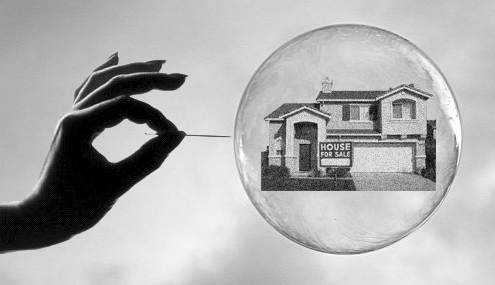
In short, this is what happened: the 2000 dot com bust led to a mild recession which subsequently led the Federal Reserve to cut rates low enough. These actions triggered borrowing and cheap money to fuel asset inflation and housing prices eventually heated up. After many years of this, the usual complacency and desire to keep the bubble going caused folks in the lending industry to resort to exotic loans and riskier practices. Credit got looser, enticing less qualified people to become heavily leveraged homeowners.
I remember how a few of my friends happily overextended themselves to own their half million-to-million dollar homes by cobbling together several loans to make it work. Things worked out for them since their homes are now valued at 50% higher than what they originally bought them for, so they’ve been rewarded for taking the risk. They were the lucky ones even as the financial climate changed and the central bank reversed its course by raising rates. Those less lucky who were carrying risky loans started to feel the squeeze, causing them to default on their mortgages and eventually foreclose.
Without expert photoshop skills to aid me, here’s my attempt at describing how the ugliness transpired:
risky loan products got eliminated —> hedge funds were hit (as they held suddenly cheaper mortgage-backed securities) —> home sales declined —> people panicked and at the end of it all —> the stock market did tank (though it has bounced back since, in reaction to the last rate cut).
This is yet another cycle of boom to bust. With history repeating itself, it shouldn’t be a massive surprise. In fact, it’s said to be a good thing for its financial health restorative effects.
So what’s next for us? We’ve got to live with some changes now. And they appear to be across the board.
The Consequences of The Subprime Collapse
Credit got tighter.
With interest rates higher, money just got more expensive to borrow. There are also tighter restrictions for getting loans: you need a higher down payment to qualify for a loan plus you need to have very good credit to get a good mortgage deal these days. A friend of mine who is a real estate investor is not thrilled by these developments at all. He tells me stories of people with perfect credit who are now at the brink of foreclosure due to tighter rules or unlucky circumstance. These people have “upside-down” homes that are now cheaper than their purchase price and are therefore unable to find refinancing for their adjustable rate mortgages due to stricter refinancing terms. Since they are unable to refinance, they become stuck with existing mortgage payments that simply grow larger with interest rate hikes. When payments become prohibitive, they are forced to default.
Buying a house got tougher.
If you’re a house bubble sitter happy to wait for lower priced homes, you may be less excited about today’s cheaper housing market. That’s because borrowing to buy a house is now under greater scrutiny. With credit drying up, all those fancy, exotic loans that allowed just about anyone to attain a new house disappeared with a whiff. “Stated-income” loans allowed borrowers to declare but not submit documentation of their income in order to qualify for these loans. These loans used to make it easier to borrow but they are now extinct. There are stricter requirements for purchasing a house today: higher interest rates on jumbo and non-conforming loans (greater than $417,000), better credit scores required, down payments of 10% or more to snag the best loan rates.
Selling a house got much harder.
For sure, you don’t want to sell your house now if you can help it. Have you checked out the comps in your neighborhood to see what kind of hit your house’s value has taken and what kind of discount you’ll be shaving off your home today? There’s more to this cycle to ride out.
The stock market got scarier.
We all know how much this market sucks. I hope you’re keeping your powder dry to buy in on the dips. I’d expect this downturn to work itself out over a period of several months. If this is a summer cyclical swoon, then come November, there could be a recovery. But don’t count on my predictions…. I don’t have a crystal ball. If you’re well diversified and have a long term view, you need not be too concerned.
Subprime Is The New Ugly But It’ll Get Better
So it looks like we’re all sharing in the pain here. Each one of us alike — debtor, buyer, seller, investor — have lighter pockets than we used to have. We’ll need to see how long this drama plays out. In the meantime, check out the following articles I’ve written to share my own thoughts about how to ride these bucking markets without feeling too dizzy:
- Shrug Off A Stock Market Slide! How To Reduce Market Anxiety
- 5 Ways To Survive A Volatile Stock Market
Hang on tight!
Image Credit: TruthDig.com
Copyright © 2007 The Digerati Life. All Rights Reserved.

{ 25 comments… read them below or add one }
Silicon Valley Blogger,
Good post. Your last section reminded me of the sage advice from the Hitchhiker’s Guide: “Don’t Panic.”
You mentioned homeowners running into stricter refinancing terms. Unfortunately, it seems that the secondary mortgage market can get a bit reactionary at times in coming up with these restrictions. Recently, I ran into a new one–lenders declining refinance loans to homeowners who have attempted (unsuccessfully) to sell their homes in the last 12 months. Unfortunately, some more bad news for homeowners, but also a word of caution to those who don’t yet find themselves in this situation. (I’m putting a post up on this shortly.)
Look, you’ve gotta stop writing about things you don’t have a clue about. You’re going to get alot of people hurt. At least do your homework. Outside of generalities you’ve shown no evidence that you can even define ‘subprime’ in a meaningful way.
You are in the bottom of the first as far as this credit problem goes. I am one to know having written over 1 billion of the loans you purport to understand. The deck is stacked against the debt-market until well beyond 2011. The extremely sharp rises in the CPI indexes should be cluing you in about now but you aren’t really watching. Like most ‘journalists’ nowdays you are more inflated with hot air than the phenomenon you attempt to describe.
This is no normal bubble. This is so unlike the correction of 2000 that it likens your attempted analogy to that of a kindergarten child sticking square blocks in round holes. Other than gross mechanics there is NO SIMILAIRITY. The Dot-com correction is a historical footnote to this credit contraction: the actual historical event. It will be difficult to begin your introductory course here but here I will try for what it is worth.
The global financial system is predicated on legal tender than derives its value from faith in data integrity and faith in data analysis: both have been lost almost completely. Is it so difficult to understand that value of intangibles will also plummet? Or that there will be a corresponding sky-rocketting in the evaluation of tangibles? Wake up! This is catastrophe.
You should be advising people to get real and to go long on things that are real instead of consoling the frog in the boiling water to stay the course and be brave. You are the shepherd of death Mr. Digital and you will reap the blind stupidity you sow along with all those who follow your blind lead.
Mike,
I’ll be looking for your post on this.
As for John Locke, I’d appreciate if you give some concrete recommendations as to how to deal with this catastrophe, then I’ll give you the floor to gnash your teeth and wring your hands like so many other chicken littles out there. Yes, I’m aware of the huge risks we face today due to subprime. But I’ve also written how so far things are isolated and unless this thing winds its way through all other parts of the economy, the pain is isolated.
Best way to approach things right now is to keep some powder dry, strike when things are at its cheapest (buy at low points, be a contrarian), be well-diversified (with what you have, stay the course or rebalance your assets accordingly) and not be overextended with credit. This way, you’ll weather the “ugly” of the subprime upheaval.
So John — let me hear what you have to suggest to our readers here. Do we all hide our money under the mattress or put everything in gold?
Yes, I second Silicon Valley Blogger and would also like to hear something concrete from John Locke. Do you recommend selling all our stocks and putting all our money in FDIC insured accounts, treasuries and maybe gold? Is that what you are doing? Since most of us aren’t in a loan business, could you also talk in plain English?
Forget about internet bubble, I am curious how you compare today with the 90s. As I remember – and I actually lived through it – the prices started going down in late 80s, went down for many years until they started to slowly go up in late 90s. It took over a decade for the real estate prices to reach 80s levels. When I was “upgrading” in mid-90s, a family who sold me their townhouse had to add money to pay off their mortgage. It hasn’t been nearly as long yet, nor have the prices dropped nearly as low yet, at least not around here (Westchester county, NY). Around here the prices are still several times higher than in the 90s, I cannot talk about other areas. Do you think we’ll drop back to the 90s levels?
To be honest, this could turn out to be a rough housing market cycle that could last as long as 6 or 7 years. It could also end up shorter than that. If you aren’t buying or selling, I’m not sure how much this would affect you, as a long term property owner. We’ll see how it plays out though. I’ve sat through many stock market cycles and property cycles so I’m wondering how different it will be this time, as per John Locke.
Sillicon Valley Blogger, it wouldn’t really affect me personally, except for when I perceive the “bottom”, I might consider investing or repeating “upgrade at the bottom/rent out old place/sell for more” thing that worked for me in the 90s (easiest money I’ve ever made) or just investing part of 401K in REIT. I’d probably wait until there are some signs of recovery.
Then there is also stock market… Nobody wants to loose money. With all the predicted gloom and doom, maybe we’ll see next Great Depression. Just kidding.
I do believe we are a few years far from the bottom, but I was curious what our “expert” here thought. I don’t remember the reasons for the 90s downturn, by the way, does anybody?
Of course if we all could predict the future, we’d all be rich.
Dear SVB, The content and title don’t really match here! If you want to find the root cause of our subprime mess you first have to ask, how is it that we have a large subprime market in the first place? Where was it in the ’70s and ’80s? Why is it blowing up now? The answer is: Bill Clinton’s Cummunity Reinvestment Act. In the 90s, the Clinton Administration began suing, harrassing, and coercing banks to lend money to bad credit risks as a way to offer homeownership to anyone in America. It worked essentially like credit quotas and forced banks to take “subprime” risks and then figure out ways to unload that risk. Like similar attempts to interfere in markets, it was popular politically but bound to end up a disaster. (If you think this looks bad, wait until we apply similar logic to health-care!)
The housing bubble is a different matter. What we now have is the 2 issues colliding and that makes it look worse than either is alone. The bubble was bound to burst (everyone knew that) and the subprime market will re-price and amount to a bad day on wall street when all is said and done. The good news here is that those who can no longer afford their mortgages will lose very little since they had no equity in the first place! In fact, I could see many mortgages converting to leases and allowing the tennant to stay under new terms. Let’s hope…
Ronny
The personal effects of sub-prime is what bothers me. Social Mobility and the American dream are at threat. There will be no more flipping and less avenues for the lower middle class and working class to better themselves. Credit will become tight and a recession will lead to a reduction in jobs. The consequences of the subprime collapse are marked.
I agree with John Locke comments.
I thoroughly researched the causes of the subprime crisis and was surprised at the paper trail that I found. Although the crisis has its roots in 1999, it was really the policies that were put in place between 2001 and 2006 that caused this crisis. I reviewed White House, HUD, and Fannie Mae and Freddie Mac press releases and fact statements as well as many Acts that were passed during that time period.
Republican Phil Gramm was the sponsor of the 1999 Gramm-Leach-Bliley Act which removed depression-era Glass-Steagall Act requiring a separation between banking, investment, insurance, and brokerage activities. Bush considered appointing Gramm as the Secretary of Treasury and now Gramm is considered as McCain’s frontrunner for the post. Gramm’s and the Republican Congress’ Act was the first key piece of de-regulation that put into place this economic crisis.
How did the repeal of this Act have a role in the current crisis? The Act allowed, for the first time since the Great Depression, banks to deal in securities which allowed them to purchase mortgage-backed securities. If not for the Gramm-Leach-Bliley Act being passed by the Republican Congress, banks could not have dealt in mortgage-backed securities.
Did Clinton have a role in this deregulation? Clinton did initially threaten to veto this Act, but eventually signed it into law. At that time, the Republicans had the majority in Congress, it was a Republican-authored Bill, and the Republicans had enough votes to override a veto by Clinton.
Nonetheless, the Gramm-Leach-Bliley Act was only the first step that was taken to create this mess. In addition to the Gramm-Leach-Bliley Act, the Republican Administration and Congress furthered this mess between 2001 and 2006. In order to stimulate the economy, stave off a recession, and feed the market’s huge demand for more mortgage-backed securities, Bush aggressively pushed the lending industry to make massive amounts of mortgage loans. To do so, he called for the most massive increase minority and low income homeownership in our history as part of his “Ownership Society” plan.
In 2001/2002, Bush created “America’s Home Ownership Challenge” in which he challenged the private lending sector as well as Fannie Mae and Freddie Mac to make more than 5.5 million new minority and low income mortgage loans. To meet his challenge to the private lending industry, 24 of our largest banking and lending companies pledged to make 1.1 trillion dollars in low income and minority loans. You can find all of the official documents in the White House Press Releases if you use “America’s Home Ownership Challenge” as your search term in the White House archives.
Bush aggressively pushed the private lending industry to make over 1.1 trillion in low income and minority lows and to “create more creative” loan products to do it. He pushed them to “loosen credit standards” and pushed them to make the most risky loan products available to the riskiest buyers. Then, he turned to Fannie Mae and Freddie Mac and threatened to not rewrite their regulatory charters.
The government-sponsored corporations created to increase the liquidity of mortgage markets, so more capital would be available for mortgage loans, are supposed to lead the market in reaching underserved populations. While these corporations have increased their commitments to these efforts, they lag behind private lenders in this regard, according to government studies. The Administration will revisit the regulatory goals for these corporations’ purchases of affordable housing loans, which are set to expire in 2003. The federal government should demand more and should hold such publicly-chartered corporations accountable for better performance.
I think Rachel’s research misses the key points. What were the underlying causes. For example, Rachel contends that removing the Glass-Steagall Act drove bad lending I have not seen the connection. For a great video on the crisis go to
http://www.youtube.com/watch?v=1RZVw3no2A4&feature=iv&annotation_id=even
So Rachel blames the Republicans. Michael blames the Democrats. Personally I would like to blame them both for their greed.
Sure a Republican sponsored the bill, but has anyone actually seen the original AND the revision made by the Democrats? Despite what Rachel says the Republicans did not have enough power in the Senate to overcome a veto by Bill Clinton. You need a 2/3’s majority. The original bill was passed with 54 votes. One of which was a Democratic vote. The House shot it down, made another bill revised mostly along Democratic lines, and then it was voted in 241-132. They then revised both bills and made a final bill. That’s just how Congress works. Very rarely can a bill be pushed through without a Congress and Presidency controlled by the same party.
The new bill contained provisions for increasing the power of the Community Reinvestment Act. This basically allowed for even looser standards on giving loans to low income families.
As I said before I blame greed and I blame these two for fueling that greed:
Billionaire Travelers boss Sanford Weill and Citibank CEO John Reed. It was they who spent nearly 300 million in lobbying efforts to get Congress and the President to repeal Glass-Steagall. Yes Michael, the repeal of Glass-Steagall does matter. Yes you guys, it was bi-partisan. “The final bipartisan bill resolving the differences was passed in the Senate 90-8-1 and in the House: 362-57-15. Without forcing a veto vote, this bipartisan, veto proof legislation was signed into law by President Bill Clinton on November 12, 1999.”
Source: http://en.wikipedia.org/wiki/Glass-Steagall_Act
Most of this mess wouldn’t have happened if this new bill didn’t give banks so much power. To the Republicans I say we do need regulation. To the Democrats I say not everyone should own a house. They are both to blame for the mess we are in and until someone steps up and opposes the special interests then nothing will change. It will only get worse.
The banks as well as the government are now buying up other banks to create some really huge nasty super banks. That much power should not be in anyone’s hands. Our government no longer serves the American people. It serves itself and its special interest groups. It is a sad state we are in. More government programs are not the answer, they are simply an expense. We need more integrity in government. I am not sure how we can get it, but I know it is what we need.
Cheers,
Jeremy
What an Excellent thread! While Rachel who blames the Republicans who authored the Bill and have congress pass it and Mr president Bill Clinton sign it into LAW… I would not go as far as blaming the Republicans. This was caused by the GREEDY politicians and lobbyists for financial giants who want more than what they can carry and pass whatever consequences to the poor people of the nation.
These Financial Giants to me are the main culprit by lobbying and getting their own way of doing things. For instance having the so called Swaps which are not regulated by the Insurance industry. By packaging the high and mid high risk mortgages into bundle of supposedly low risk investments. What a genius idea only if the homebuyers will continue to come to provide a never ending stream of river of CASH…
Just my 2 cents,
JGVFinance
It seems to me that it would have been smarter for the government to refinance all the “bad” loans into 40 year loans at a decent interest rate. Most people want to keep their homes if they can and it would certainly been cheaper then the bailout which hasn’t worked as the PTB’s are hording the money. And as always the little guy gets shafted. They need to make it so that if you borrow money from x he can’t sell the loan to y (this is an incentive to make good loans). They also need to make the language of loans easier to understand. And when the 1st S&L mess up happened way back when (Remember the Bush brothers getting bailed out?) they should have hung them. I’m sick of a government that isn’t for the people only for the rich. There are a lot more of us then there of are them and they should remember the lessons of the French Revolution. When people feel they have nothing else to lose they will revolt.
Racheal and Michael both make excellent posts. The thing which scares me most about this whole thing is that the most prominent media outlets do not mention any of this which leaves the average American left suffering the consequences but with no clue at all why it happened. Why is it that such topics have not entered the public debate? Why do I feel that this is all being covered up? Most importantly, what can we do to make sure that all the people get the facts so, hopefully, this doesn’t happen again?
Everyone is doing their best to pull through in these hard times.
What causes a subprime mortgage is a loaner speculating that the borrower will be able to pay back the loan. The loan is suppose to analyze the borrowers income, debt, etc.
You know, this is what’s great about blogs – what one person wrote is getting others to throw in information (even some of them have axes to grind). I feel like I’ve learned a lot about the mortgage crisis from the comments alone.
In hard times, everyone should work hard as much as possible and try to improve their fortune. I like this article.
It’s pretty tough to throw one political party under the bus although Silicon Valley Blogger certainly makes a good case.. But I’m not entirely convinced; I’m more of the opinion that regardless of political action or inaction on either side, the collapse of the housing bubble and subsequent financial crisis are directly the inevitable effect of un-restricted and unregulated capitalism; Greenspanomics is simply unfeasible, and we do not have the “moral character” to “regulate ourselves”.
Thinking about the subprime mortgage crisis and the cyclical nature of economic collapse can be downright depressing. And I agree with @Kev… major media outlets seem incapable of delivering concrete information on this type of thing. It seems like the best information comes from blogs like this and comedy shows like Jon Stewart and Stephen Colbert (as bizarre as that seems sometimes). Still, I don’t think you were wrong to end on a positive note. After all we are all in this together.
It’s a shame. We are still trying to recover from the sub prime fiasco. And I still see stuff going on that shows that “we” really haven’t completely learned our lesson from the consequences of the past. Basically, greed ran the day and still is. I still think we need more strict standards and tougher policies.
I hope that the subprime crisis is over, but I really can’t see it being over. the housing market is in too much trouble for it to be over. Do you think that we will see more pain in the future? Here are some more details on subprime.
What is amazing is that so many of the big banks were involved in subprime so deeply. In the beginning it was mostly the specialty subprime mortgage companies that made these loans. Then all the banks jumped in.
I totally agree with the fact that buying a home is tougher day by day. We are a working couple and planning to purchase a new house. We are exploring new options for mortgages; however it seems difficult to own a house.