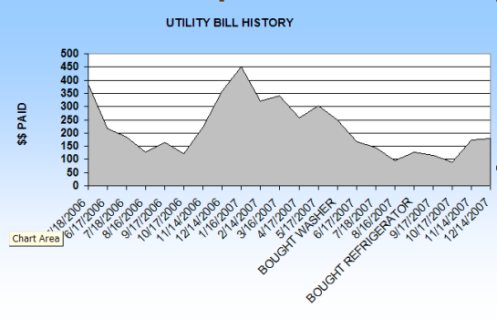
Our conservation plan is working. Our utility bills are down 25% from last year!
We’ve recently found out how successful our plan was to replace a couple of ailing appliances that we inherited from the former owners of our home. Some couple of decades old, one appliance was our standard white fridge and the other was our groaning washer. By replacing these twin household legacies, we are now enjoying 25% lower utility bills every month: from $200 a month to a more acceptable average of $150 a month. This isn’t as good as it can get of course, since we haven’t decided whether we’d do something more radical such as go green with roof solar panels. But we’re still pretty happy with the results.
It seems that a lot of can be done to really cut down on energy and utility costs if we commit ourselves to the cause. But some of these improvements may require a bit of outlay or investment in newer household tools and items. This went against my frugal mindset because I preferred to make things “last longer” in order to avoid having to buy something yet again. But we are now seeing that it’s worth it and at the rate we’re going, we should pay off the cost of our $1,200 fridge and our $800 washer (before applying several hundred dollars worth of rebates) in about two to three years’ time.
Here’s how our utility bill has fared throughout time:
In that vein, I’d like to offer some Dos and Don’ts for wrestling down those household energy and water bills.
Surefire Tips For Bringing Down Your Utility Bills
DO replace your ailing old appliances especially if your bills are excessive. Swap them out with Energy Star appliances that automatically provide you rebates. In California, we pay $0.11 per kilowatt hour for the first 73.8 kilowatt hours as our baseline and the rates go higher quite a bit the more power is used, so those savings add up a LOT.
DO replace your toilets with lower water use models. Hmmm…. this way, unless we have a terrible drought come upon us, we won’t really need to go so far as to leave toilets unflushed just to save water — an idea that gives me the willies and that seems to be more common than you think (at least from what I’ve seen)!
DO cut down on water costs by opting for showers instead of baths plus you can also install low-flow showerheads that better control water release. Did you know that a bath takes four times more energy than a shower? You don’t have to skip out on good hygiene to save money.
DON’T use appliances during peak hours if you can help it.
The amount of electricity you purchase each month is the result of two basic components: the electric use of each appliance in your home (watts) and the length of time you use the appliances (hours). You can reduce your Time of Use bill if you can shift the majority of your electrical requirements to off-peak hours.
Apply full loads when you use your appliances to shorten your length of usage.
DON’T turn up your heater or air conditioning. Instead, consider using a programmable thermostat and make do with more or less clothing. 😉 How about caulking your house up and improve insulation on your house? Insulating and weatherizing your home will save you a bundle — maybe a few trees around the house can help as well :).
DO shut down and turn off your power at night if possible. Less use, less money spent. If you’re going to develop a habit, this is one of those good ones to pick up. How about replacing your old bulbs with the more energy efficient fluorescents?
DO launder with a few steps in mind: readjust your water temperature to 120 degrees, wash and dry in cold water and clean your dryer lint traps regularly. Pull clothes out of the washer slightly damp instead of when they’re completely dry and maybe consider going back to the basics to some degree by hand washing and line drying some of your laundry.
DON’T buy the biggest appliances although you may be tempted to pick up the SUV versions of these items. Unless of course, you can manage full loads every time you use them. Oversized items, like anything else bigger, will cost more to run and use. For energy efficiency, opt for appropriately sized appliances that run on natural gas if at all possible.
DON’T forget that there are a lot of incentives available for buying more environmentally friendly products. Rebates, coupons and discounts can abound, so with a bit more product research, you can be on your way to spending less.
Copyright © 2008 The Digerati Life. All Rights Reserved.

{ 21 comments… read them below or add one }
It is amazing how much you can save sometimes with newer appliances. Our electric bill in a bigger house has been less than our old smaller house, I believe mostly due to these more energy efficient products.
We replaced our bulbs with CFLs last summer and noticed a small drop in our bill. We also got rid of a dinosaur dryer with bad seals and an inefficient heating element. That move alone has dropped our bill at least another $20 a month (family of 5 did a lot of laundry – my grandfather lived with us at the time).
Great post! I’m always looking on ways to save on my utility bills and I’ve actually found some relief this winter with a vent-booster called the airflow breeze.
I plugged it into my vent in my bedroom which is always way too cold and now it’s comfortable again!
My bills are lower and I am saving a lot of energy— so I’m green too!
You should really tell your readers about this great product, it has really saved me this winter!
You should actually track actual electric used and not bill amount, you might even be saving more than you thought if your rates have increased!
I just had a brand new refrigerator (with an outside water dispenser/ice maker) and 6 burner stove delivered. I have a very large family (7 kids) and so we had to get the huge size. I decided to get the fridge with the water dispenser and ice maker because I read that every time your fridge door is open, it costs money. I didn’t even think about the fact that the huge fridge will be pulling electricity just to keep the ice maker full. At least, the ice will be used when the kids are home from school. Both appliances are supposed to be energy efficient. 🙂
Let’s see what kind of bill I get in February….
Terrific post! Regarding the tip on replacing toliets with lower water use models, instead of going out and buying a whole new toliet, you can reduce the amount of water per flush easily by adjusting the float that sits inside. This sets how much water is in the tank to be used for each flush. This can be found on most household toliets. Cheers!
Great job with lowering those pesky monthly utility bills!
great recommendations. it is fascinating how money can be saved by just paying a little bit more attention.
Here’s an easy water conservation tip. Install a Hot Water Lobster. It is an instant hot water system that will save water, time, and energy! In many homes it takes a long time for hot water to circulate to the faucet or shower. Water is wasted by waiting for the water “to heat up”. The Hot Water Lobster is an electricity free solution. Installation is quick. It can be installed in less than ten minutes and it only costs $179.95.
The Hot Water Lobster was developed and is manufactured in the United States. The Lobster is designed according to strict manufacturing standards to ensure easy installation and long maintenance free operation.
Check it out at:
http://www.hotwaterlobster.com
That graph is great… I’ve been thinking about replacing “ole frosty” too… Ours is a 40 year old refrigerator that sounds like a diesel truck when it cycles on…
I’d love to know how much money we could save.
I phased my energy-efficient light bulbs in. Everytime the non-green bulb would go, I’d replace it with a green one, so they’re all energy efficient now. I tend to switch off all my appliances from the mains, too.
I think more people would switch if they could see that there are medium/long-term cost-saving benefits to being more green-conscious.
Thanks for sharing your tips.
take care…
Congratulations…great progress there. Sounds like you got most of the savings with a couple of new appliances and a few frugal habits ?
Would be interesting to see if more insulation and some weatherstripping would affect it more. Heating and cooling are typically bigger users of electricity than anything else.
Did you know that refrigerators with the freezer on the top or bottom are more energy efficient than the side by sides. Not only that but having an automatic ice maker uses even more energy.
Awesome article! Thanks for taking the time to graph out your savings after buying those Energy Star appliances. They really make a difference.
Some very interesting ideas and comments. I came across this page whilst looking for cheaper energy prices. My bills haven risen by 35% this year and am now facing yet another increase by these greedy energy companies. (Thankfully I only rent so don’t have to worry about a mortgage as well.) Has anyone tried this green and cheap renewable energy? If so, be interested to know how it worked for you.
Nice one. Those products will help us to save on our electric bill.
Some very good tips! With todays economy, not to mention the state of global warming, we all need to conserve. Thanks
Keep an eye on the provider! Reduced consumption (conservation) can mean serious declines in revenues to the utility.
Very interesting findings, I will be going down this path.I have a very old freezer, sounds like I should update it and save some dosh.
Looking for green energy? Here are some ideas.
Living off the grid is definitely the way to go. Me and a friend of mine use magnetic motors to power our houses, and sell the the rest back to the power company. Not only do we save thousands in power bills, we make money from selling the power we don’t use, its brilliant.