How to become a millionaire by saving money to the extreme.
While there are people who love to flaunt whatever they have and give the impression that they are wealthier than they truly are, there’s this subset of individuals who work in completely the opposite way: these people are the ones who are wealthier than anyone ever suspects, and are only discovered as millionaires right after they have passed away and have bequeathed their millions to others.
I’ve always been quite inspired by such people, but also wondered about what would possess them to hoard money in this manner. More often than not, it’s an issue of control, with “pack rat like” behavior extending to money as being the object of choice to squirrel away in this extreme fashion.
Saving Money Goes Extreme: Stories Of The Unexpectedly Rich
These people have been called many things — from rich paupers, to millionaire eccentrics, to the “surprisingly rich”. Here are some accounts of people who’ve lived under the radar while secretly stashing away their money. They’re living a double life. I don’t know about you, but I find this somewhat cool and intriguing.
Joseph Leek left nearly $1.8 million to an organization that provides guide dogs for the blind, and nobody, not even his own family, had any idea that he had that kind of money. The 90-year-old Britisher lived like a pauper. He watched television at a neighbor’s house to save on electricity, put off home repairs, and bought secondhand clothes.
Rev. Vertrue Sharp raised hay and cattle, preached and taught, while saving every penny he made. When he died in 1999, he left an estate of $2 million to the East Tennessee Children’s Hospital, the University of Tennessee Medical Center, and other charities.
English spinster, Mary Guthrie Essame was a retired nurse who lived in an old Victorian house and who clad herself in such worn clothes and old shoes that no one knew how well off she was. Neighbors were shocked to learn that her estate amounted to a whopping $10 million when she died in January 2002. (The money was left to a host of charities.)
Have you heard about the elementary school teacher who built up almost $4 million dollars by the age of 89? There was also the 55 year old transient who lived in a trash-filled hotel room who had $1.4 million in Wachovia stocks and funds because he was afraid “his health would go bad” and that he needed to ensure he’d get medical attention when the need arose.
And here’s my favorite story of all:
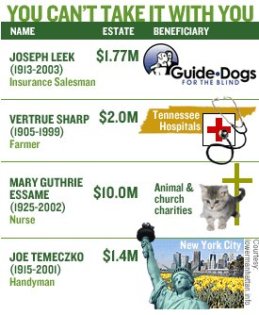
Joe Temeczko was a Polish immigrant and former prisoner of war who did odd jobs and handyman repair work. He had no family and lived in a modest house which he filled with stuff he scavenged from the streets. He roamed the neighborhood to find junk to fix up and sell or give away, and would get free food from local charities and read newspapers in the store so he wouldn’t have to buy them. When he passed away at the age of 86, he left behind a $1.4 million bank account which he gifted to the City of New York. In fact, he’d rewritten his will right after 9/11.
Interesting Notes About The Secretly Wealthy
- There are more people of this profile than you think. Don’t look now but the shabby clothed guy standing in the corner can be worth millions.
- A lot of these folks become philanthropists and leave the bulk of their money to charity. They are ordinary people who want to make a difference in society, and who’ve done it in a special way — by allowing their money to grow throughout the years, enabling them to bequeath a large gift to their causes and helping them make an impact upon death.
- On the other hand, family members of the secretly wealthy have also voiced their disappointment in finding out that they’re actually richer than they thought they were. Many have lived lives of sacrifice and deprivation affected by the lack of knowledge about their true financial status. This true status is a closely guarded secret by the patron (or matron) of the family throughout their lifetime. Not surprisingly, this can trigger a backlash among the heirs, who may then proceed to spend their inheritance willy nilly.
- Many of the secretly wealth are actually quite happy and content just living the way they do (as reported by those close to them), although I’m rather baffled that anyone would like to live in flea-bitten hotels, seemingly poverty-stricken, when they could afford a decent apartment.
- Keeping one’s riches secret has been looked upon as a control issue, although these extreme frugalists appear to have the common desire to surprise their heirs when they die. For those who pretend to be poorer than they are, it could be due to having the baglady anxiety syndrome, where they feel that no matter how much they have, it can all be gone in a split second if an emergency arises. Or they may just feel more comfortable hiding their wealth so that it could grow uninterrupted, away from prying eyes and others’ involvement.
- They may also enjoy and derive pleasure from the idea that they can become the “hero” once they die and leave a legacy to others.
Odd behaviors aside, these stories should prove one thing: that ordinary people CAN indeed find themselves sitting on millions by simply living frugally. Though I can hear you all making the argument that a lot of these folks are found to be millionaires only after many, many years of scrimping and only upon reaching the twilight of their lives, you really can’t argue with the hard results: they still have a million dollars more than most of us have.
Copyright © 2008 The Digerati Life. All Rights Reserved.

{ 38 comments… read them below or add one }
I agree that by living frugally and saving all we can then most people can become very wealthy. However, what’s the point if you are just going to die and not get to spend any money ever? These people may have a million or more dollars then me, however I bet I enjoy life a little bit more.
Interestingly, I can see some of myself in these stories. I don’t think I’m frugal to the extent of a gross apartment, but I do prefer to live simply and keep my balances private.
Do you think it’s because they lived through the Great Depression that they saved money like this throughout their lives?
I say this because my generation hasn’t lived through any serious economic strain (‘cept the ’82 recession *maybe* with some conscious memories) and perhaps there is a reality brickbat coming to hit us in the head with the subprime meltdown?
@Dreamer
The point though is that these people may actually enjoy life their own way. Some may have OCD (obsessive-compulsive disorder) and not necessarily be too happy about it, a side effect being that they hoard money, but there are some that may actually just be truly content and happy living *very* simply and modestly. Although not to this extreme, I have come across some people who come from very modest backgrounds and have been teachers/professors all their lives. They shop at Ross and Marshall’s. They love garage and estate sales. They only get books from the library. I’ve tried to get them to “spend more” of their money but to no avail. Result? They’re financially set and are multi-millionaires.
They’re also very happy and content and say they’d never trade their lives for anyone else’s. They just don’t need to spend to entertain themselves (their idea of enjoyment is reading a library book while sunning themselves on the patio).
Excellent article! Well it appears that their security and sense of well being were related to the amount of money they had hoarded. Perhaps that huge figure gave them a sense of peace from their fears and insecurities.
We live only once. So there has to be a healthy balance between our needs and wants. Peace of mind, love and inner joy are our greatest wealths. The last time we checked we found that we still cannot take any of the money we accumulate :)).
Cheers,
FIRE Finance
My jaw just dropped. Not because of the frugality, but because I’ve been called a money hoarder by some of my friends. Albeit, these friends are up to their necks in debt. But dang, while these stories contain elements of admiration, I also feel a little sad for these people.
To borrow a phrase from the popular talk radio host, Dave Ramsey…”Live like no one else, so later you can live like no one else.” The secret is that “later” should come before you die, so that you can enjoy the benefits of your sacrifice.
I think, unless I had OCD and a problem with needing to save, I’d probably have slightly increased my standard of living as I got older. Not by much, but by more than they seem to have.
As for leaving it, if I’m rich I plan to leave a certain percentage to charitable groups and the rest to my kids. And train the kids to handle money…without expectation of a great inheritance but with some idea of my financial standing. (Without expectation because a number of things can lose the money before I’d die…end-of-life care, stock market issues, etc.)
I have to second what the Frugal Dad said.
If you cannot use your wealth to benefit your family (even in a small way), I’m not so sure your priorities were in order.
But, hey, it’s THEIR money. They can do with it what they wish.
When I said I thought it was cool that people can save so much in this manner and live as if nobody knew their “secret”, I actually meant that I admired how they stayed humble and lived a low key life despite their “riches”. I agree though, that if a family ends up feeling deprived and unhappy, it’s something to frown upon, especially if this is just a symptom of taking “control” over one’s family.
There is a balance here somewhere.
I have to feel as if these people lived a sad life, When you deprive yourself just to stack money is a little selfish, seem like they do not know how to enjoy life and loosen up
The Millionaire Next Door is one thing, the crazy cat lady is another. Nothing wrong with living well within your means, but it is obvoius that some of the examples had psychlogical issues they were dealing with too.
I agree: balance is key. I agree with Mrs. Micah that your children need to know how to handle money so that, if there is money left over after you pass away, it doesn’t get squandered.
Neat article. I love to read stories of interesting people like this 🙂
I think the stories are nice, some people don’t need alot of material possesions around to be happy. Some of them were probably just really cheap.
The only part that bothered me was “He roamed the neighborhood to find junk to fix up and sell or give away, and would get free food from local charities and read newspapers in the store so he wouldn’t have to buy them. ”
Getting free food from local charities and having enough money to provide for oneself is not okay. Those charities and organizations provide meals and assistance with the assumption the person receiving them is in financial need. Using others resources because you don’t want to use your own is plain old cheap.
My husband used to go to a shooting range and the guy who sort of ran the place wore old clothes, lived in a run-down trailer and held his cane together with duct tape. When he died it was discovered he had $800,000.00. Don’t know who it went to, but all the guys who frequented the range were quite surprised! I taught school with a guy who had several million he inherited. He drove a car in which he had to put oil each afternoon before driving out of the parking lot, he never had a gas bill to speak of, because he never ran his heat in his house – we live in So. Cal., and he only put his money into banks $100,000.00 at a time, because that it all that they would insure.
Yep, there are a lot of surprising stories out there and often we think, “why don’t they just spend some and enjoy it?” However, when I look around at the stuff that I have purchased and later gotten rid of….I find that I get much more joy now out of watching that bank balance grow.
I can say that “I know what they mean….”
I’ve always thought about this myself. I find myself being cheap when I don’t need to be because I have a little bit of money. Sometimes I find myself not enjoying the wonders of life and worrying about money more than I need to be. Great post 🙂
You know, some of these actually bothered me. Like what JB said – if you can afford food you shouldn’t be taking from charities that give to the needy. And the one who watched the neighbor’s TV? The neighbor should use the electricity not him?
There is frugal, and then, there is cheap.
I find these stories inspirational too, thanks to their “anyone could do this” quality. But as you said, the extremes to which these people go are often disturbing, to the point where I can’t help but wonder if there isn’t a mental illness factor. I prefer the story from The Millionaire Next Door about the bus driver who saved money, studied investing, and made a quiet fortune in the stock market 🙂
I find this story inspirational.
If these people actually thought of and went out of their way to leave their fortunes to charity, then probably they must have considered family alternatives and decided otherwise.
There is a lesson here. I speak for myself. But I have never gone through any period of serious deprivation. So I don’t truly, truly know the meaning of having to be frugal.
I’m like that. I have tried it the “normal” way, married, two good jobs, got my nice house, nice car, beautiful kitchen and I wasn’t any more happier then when I was living short on cash.
Now I try to ignore all the money that’s coming in, I think of it as cursed. I come up with reasons not to spend it, so it won’t taint my current lifestyle. Then hopefully when there is enough to stop working, I will still be able to enjoy it. I might fail and end up in the above category.
Is it worth having millions of dollars if you don’t spend it? It is noble to give to charity and I would count that as spending it.
However at some point, you’d have to question Temeczko getting free food from charities only to later donate money back to charity.
What’s the point of having all those money but not being able to enjoy? Unless the goal is save the money for the charity. I guess most of these people just live a life which they can’t live without with to save every penny.
Enjoying life is a deep question by itself. What does it mean to enjoy life? Let’s say you spend money, buy stuff, go on vacations and so on. Your physical body hasn’t changed. Your brain waves justed fired off — could be new brain waves or could be the same neural paths you always use — and new memories appear slowly pushing out old ones.
Could you have activated these same neural pathways using alternative methods? If so, how much did spending money contribute to the enjoyment of life when in reality, it was simply a trigger to electrical activity in the grey blob in your head?
I’ve pondered this periodically because spending money does not trigger the usual sense of satisfaction in my brain. I also know that whether I enjoy life or not, I still will end up in the same place — 6 feet under with worms eating through my brain. The only thing that will ever survive me is my legacy — via both genetics and memory. Perhaps acknowledging this fact upfront let’s me trigger via accomplishments the same pleasurable neural pathways other people get from spending. In effect, I am enjoying life because it’s all in the mind anyways.
@ MossySF you are right…
Of course there is the other side of the coin as well, those souls who would have friends and neighbours believe them wealthy… when they are broke.
I always have a nagging duality in my thought about philanthropy. On one hand its awesome to hear that these guys saved $1million or whatever and gave it all away. But maybe the world would be a better place if people gave it as they got it? I know that some of these guys are prodigious investors etc. Like say Warren Buffet 20% per year, he’s done very well, and could make a major change in the world.
But take me for example: I save $260 a month and lets say I get 7% over my life time… Is the world better off getting my $260 a month to help someone today (who in turn may help some people too etc. etc.) or is it better off that I shun the poor/needy now and try to “catchup” on all the philanthropic work that I missed in the past 40 yrs with the $650,000 that I’ve saved up…
Another note on “philanthropy”. The world spends roughly $1trillion on military/weapons. If we could convince the world to take 25% of the military budget and put it into philanthropic uses of some kind (domestic and foreign) that would be like 5 Warren Buffet estates every year. (PS. Sorry to Warren for being so morbid, I hope you live a long happy life.)
Thoughts and comments?
Your money is to support your life … your life isn’t to support your money.
I made money … I saved money … I also spend/donate money … now, I also write about money … so here’s what I have learned:
You CAN have it all PROVIDED that you know exactly what ALL means for you (and, if it JUST means “wine, women, song a.k.a. sex, drugs, rock’n’roll” you DO have a problem, just like the “save every penny” folk). AJC
This reminds me of Anne Scheiber’s story:
http://money.cnn.com/magazines/moneymag/moneymag_archive/1996/01/01/207651/index.htm
Most of these people die with a ton of money, yet with no one to share them with.
I have to agree with RacerX. Millionaire Next Door type of savings is admirable, but the whole eating cat food and watching your neighborhood’s tv is just plain sad.
I once worked with someone who would eat moldy food and collect everything people would throw out around the office, but he was always generous with his church and bring goodies to work. But after knowing him better, I was afraid to eat anything he would bring into the office because I wasn’t sure about the quality of the food (how old it was and all that). And I know for a fact that he is worth tons of money even though he looks like a poor old man and that is in addition to his government pension.
I grew up really poor myself, so sometimes I get the bag lady anxiety. I look at my balance sheets, take a deep breath, and realize that I am doing pretty good. That seems to be working so far. I am so afraid that someday I might end up as one of these stories on someone else’s blog. =)
I love this, it’s amazing when a person can really live a very “poor” life and not have to. Money really does not buy happiness and what a wonderful lesson for us all.
Wow, these are really surprising facts! I had no idea there were so many secretly wealthy people. Thank you for letting us know about them! I am especially taken by the idea that most of them were happy living frugally, sometimes to extremes.
Joe T…, the Polish former POW, etc. who gave NYC his fortune after 9/11 left it explicitly, I believe, for flowers for the city of New York. His story is chronicled in DOUGH, a wonderful book.
I am stingy, but I don’t have the money these people do.
However, my kids suck, so I am not leaving them squat. They’d sell me down the river in a flash. They’d bilk me out of whatever I have if they can.
I’m leaving it all to charity. I am divorcing my husband at this time. After that, I am having my lawyer make an iron-clad will.
You can make money work for you instead you working for it.
A study conducted found that many money hoarders have OCD. I know I have it a little bit.
I don’t believe in going without food and wearing holey socks to save a million dollars. I also don’t believe in depriving your family while you squirrel away all the acorns. If I ever managed to save over a million, I’d want my children to do the same.
I do believe in saving a healthy amount and spending less than you earn on most. Too many Americans over-consume and think happiness lives in a store. Most Americans have good credit but high debt. They have less than $10,000 saved for retirement or no savings at all. Too many people put their kids in expensive private schools whether they can afford it or not, lease two brand new cars, buy cell phones for eleven-year-olds, spend $25 on one bottle of shampoo and $35 on skin creme, eat out five days a week and mortgage too much house.
These money hoarders are actually in the minority. I think they also hoard because they earn or earned what most people do: a crummy salary. Not six-figures or more a year. They knew no other way to realize their dream of becoming a millionaire.
We all could learn a little from some of these money savers.
I live frugally partly to save money for the future, b/c so far it’s promising to be higher medical expenses and huge inflation making more money do less. But also because I just feel the need to challenge myself. When I have all my comforts met, living in a nice place, great food, etc, etc…being pampered…I just feel like I’m a worthless human being. I feel like there’s no reason to live, because everything is just … there.
All of Maslow’s Heirarchy of needs are met, so there’s no longer any challenge, and with that there’s no contentment. So, I strive to live below my means. I still live in decent neighborhoods, because I value security. But I try to walk or bike to places rather than take a car. I try to scavenge things I can use by doing freegan or shopping thrift stores. I don’t own much stuff, because the more stuff I own the more worries it causes. However, I own everything I need (just, in some peoples’ cases, not everything they would want…EG: I don’t have a fancy sports car or house or other toys). By simplifying my life, I find a sort of calm peace. By scavenging things, I feel euphoric when I find them and feel like I’m doing some good by giving them a second chance. I mean, ANYONE can go out and BUY a NEW whatever, but I find something I can use and it’s free and just needs a little TLC.
Some of the best clothes and computers I found for free or at bargain prices. I guess it comes from a nomadic hunter/gatherer instinct. It’s not satisfying knowing I can just go to some store to get stuff for a ton of money. It’s more satisfying having a scavenging hunt and finding things for free. But that also means I can save up some money to invest, or to donate if things look bad in certain situations. There’s a standard of living I won’t accept less of, but that doesn’t mean I have to “live like the Jones'”. Just like it’s surprising to find out that successful-looking guy in the BMW with the awesome suit and smile is 100k in credit card debt, you’d be surprised to find out that guy at work that bikes in every morning, dresses plainly, and does his job quietly and just gets things done…is slowly working his way towards being a millionaire. And, unfortunately, will probably die as one, too…because like a slipper slope, once you get this frugal mind-set, you have a hard time convincing yourself to spend money on things. If a health issues arises, our youth teaches us that if we just wait it out it will almost always get better. But then you reach an age where it won’t get better. But you delude yourself into thinking if you just wait it out…and then it kills you. And all that money you saved up gets spread back across the land again.
I hate to dissolution anyone, but a million dollars today is really just chump change, but because of the recession, it looks like much more than it is to the average person.
To these people, their lives are not sad. They know exactly what they’re getting into.
Nobody is saying that in living this lifestyle, you have to deny yourself EVERYTHING. You are saving, period. I know lots of people who are just putting off getting and doing the things they want.
Breakwater 88, you are so right. However, if a lot of us get there, it might be a great thing.