Am I supposed to believe the fact that the median priced house in America today only costs 22% of the median income compared to 20 years ago when it supposedly cost over 30% of that income? Today you’re expected to only spend 22% of your pretax pay on mortgage payments to buy the typical house, which I was quite surprised to read. Well that’s according to the NY Times. It sure doesn’t feel that way to me, living here in California.
But of course it’s a different story in different parts of the nation. This splintered real estate market has been discussed time and again as lopsided across the board, but the hard facts bear repeating:
In the United States, there are 35 “affordable” markets and 28 “moderately unaffordable” markets. Seventeen (17) markets are “seriously unaffordable” and 27 markets are “severely unaffordable.” However, these data tend to overstate the extent of the affordability crisis in the United States. Ten (10) of the US “severely unaffordable” and three (3) of the “seriously unaffordable” markets are within the larger New York, Los Angeles, Boston, San Francisco and Washington metropolitan areas.
Thanks to Demographia’s 2007 Housing Affordability Survey we’re getting the real story:
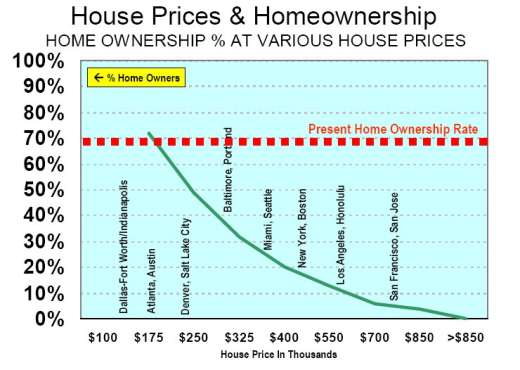
What this shows is that hardly anyone owns houses that are approaching $850,000 and beyond, yet that median price doesn’t seem too far off in California’s future.
Yes, yes, this is what we’ve already known all along when we scour the pages of the Homes And Land magazines and the MLS Listings looking for that promising piece of property we could claim as our very own domain. Could that sweet little cottage with the modest but lovely patch of lawn actually turn us into real millionaires one day?
Then I come across a story that REALLY proves the point, without a smidgen of a doubt, that we are indeed living in a surreal time for real estate, especially in the most expensive locations in the country. This story is about an assistant professor named Alphonso Newcomer, who joined the teaching staff of Stanford University in the late 1800’s. Stanford needed to build its faculty for their most popular department, which was their English department. Now, this professor’s reputation shined and his prominence rose as time went on, and he had a house built in 1896 on 1055 Forest Ave., Palo Alto. He was a fairly young guy, because he actually died at the early age of 49.
That first time homebuyer who was a respected professor by profession surely had a great house with all the amenities, which The Examiner describes to us further here:
“It had a deep entry porch, a reception hall, an office with multiple workstations, a sunroom, a very large dining room with adjoining music room, a master bedroom suite with a library in its own wing, an exercise room/dance studio, a wine cellar with a tasting bar, a swimming pool and a waterfall spa.”
See, this great house is no longer a house by our standards, but a mansion, worth all of $17,000.000.
Where: Palo Alto
Asking price: $17 million
Property tax: $221,000*
What: 7 bedrooms, 4.5 baths, 7,523 square feet per tax records
Amenities: Asymmetrical facade, gables, classical columns, painted wood gutters, enclosed front porch, wood sash windows, fireplace, French doors
Contact: Sherry Bucolo, Alain Pinel Realtors, (650) 207-9909
*Estimate based on 1.3 percent of asking price
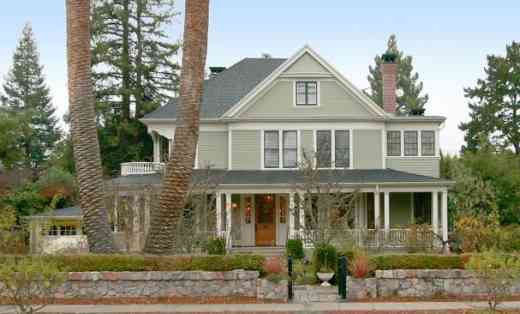
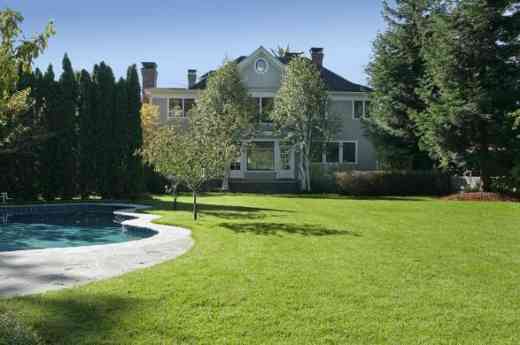
So THAT, my friends, is what your college educator’s salary bought him in the last century, here in Northern California. Does this mean that in the past, anyone could’ve afforded a house like this? I’ll say that long ago, the job market and the economy were at a point that certain professions could’ve been rewarded more so than others. The haves and have nots existed but not in the way you’d expect today. A home like this is now beyond the dreams of any typical individual and is primarily reserved for the decamillionaires of today. Then again, this house is located in the most expensive city in one of the most expensive parts of the nation. So is this phenomenon about the market or is it about location?
Here’s the craziness of it all. These days, I’ve seen professors and other hard working wage earners fight over a place in line for this kind of prime real estate. I’m still shaking my head over this one!
Copyright © 2007 The Digerati Life. All Rights Reserved.

{ 15 comments… read them below or add one }
Very interesting facts, but a lot of talk about real estate is so general. The problem is that real estate is a local market. You can’t talk about real estate the same way you can the stock market.
Stocks have one price and it goes up and down. Real estate has as many different prices as their are properties. Sure california is expensive right now, but do professors in nebraska have the same problem?
-limeade
Good points limeade! I’d love to hear from people from other parts of the nation to find out if regular people can purchase mansions much more easily. Given the house’s features: 7,000 square feet, 7 bedrooms, etc, is this something that a regular college professor can buy somewhere else in the country? To me, it still seems like a lot of house anywhere though.
I have a close friend who lived in Orange County. They traded their beloved tract home for a 5 bedroom, 5,000 sq ft “mansion” in Minneapolis a few years ago. I believe it cost something like $500,000. Still nothing to sneeze at!
I unfortunately believe that this is a reality that we will have to face in our lifetime.
In 1900 the population of the US was only 80 million, vs our 300+ million people now. Today the majority of these individuals living in coastal cities. Last time I checked the US is losing more land to erosion each year than it is gaining.
Regardless of short term trends I really don’t think the US will be losing people any time soon(we will continue to be the fastest growing industrialized country) If its expensive now I can only imagine how expensive it will be in 30 years.
Being a professor or other profession in the nineteenth and early twentieth centuries was very different today. Here is a an example I Googled and I’ve read similar things before:
http://www.beloit.edu/~libhome/Archives/papers/profsalary.html
Such people had servants and big houses. Society was much more unequal and therefore servants cheap and the number of college students and professors small. More like India today.
I guess that is why I need to move to New Mexico and buy that land that I want…
Moom,
Thanks for the research! Sounds like professors and academicians were part of high society then. How times have changed.
David, I read about your trek into New Mexico! Sounds exciting. I’ll be seeing what you do about that.
DebtToDreams, our larger populations are something we need to keep wrestling with as time goes on. I have the same thoughts you do.
I don’t know how anyone is able to get started in life while living in California. My wife and I are hoping to move out of state soon.
I rent an apartment for 1070/mo (2bed/2bath) built in the 1962 in San Diego. The homes around this area are 2 and 3 bedroom 1 floor homes, at about 1200 sq. ft. These homes were *selling* for $530,000 last year. They’ve fallen to 470k, and I’m expecting them to settle back at 300k in 3 years.
The sad thing, is that these homes were also built in the 60’s, have deteriorating plumbing and poor electrical systems. I wouldn’t buy one of these homes for 75k if they were suddenly on sale, but I’m stuck. Rent is more than 30% of my take-home pay, and electricity isn’t cheap either ($150/mo w/o AC).
Renting a newer place in a safer neighborhood is impossible. I’m a software engineer, paid at educational fair market rates. These rates don’t pay the bills. That’s what’s wrong with the housing market.
Hi, I just came across your blog and like it a lot. Thank you for the information. I see you are interested in real estate properties. You might want then to visit this site to see some more very expensive real estate.
Most Expensive Real Estate
The problem with the Real Estate market is simply that most of us want to live in the same few places.
If someone is a typical ‘go-getter’ they have to move to NYC for Finance Jobs, Virginia for Defense, San Fran for Tech jobs, Las Vegas if someones a Stripper, etc.
If more cities could develop better nightlife, colleges, and jobs the price of homes will stabilize or even decrease.
We have plenty of land in the USA but jobs are simply not spread out evenly.
Paul, where in SD are you renting 2 bd apartment for $1000? That is super cheap, I know because I’ve lived there. And I still have a ton of friends there. When we left DH and I were paying $1200/month rent in 2002 for a 1 bd. It depends on where you live. BIL is still living there and paid $1400 for 2 bd apartment this year, but in not as nice an apartment. Friends rent a home for $1600, but that’s because they know the owners. Homes in that neighborhood rent for $2500 usually.
It depends on where you live in SD. The south part of SD is cheaper than the northern parts of SD.
Wait a sec though. It sounds like some of those amenities were added by later buyers. I’m not sure that 1896 was quite so fancy, though I am sure it was fancy for its time.
“Wine cellar with a tasting bar, a swimming pool and a waterfall spa.” I doubt ‘tasting’ wine was as much a past time back then, as sheer drinking it was.
Where’s the carriage house for this place? Surely they had stables for this house instead of that attached garage?
Either way, I don’t know many professors of any stripe that can buy a $1.7 million house unless they are teaching something like finance.
I live in the Midwest and don’t understand how anyone affords a house in California. It cost about $100 per square foot in my area.
The only thing I can think of maybe he wrote a couple of books or could have had family money, there are several ways he could have had money to contribute to owning a house of that magnitude. There are housing developments all around me that run around 500,000+ per home and I have no idea what the people do to earn that much money especially in such a small rural town that I live in. I live on a farm where our family has always lived and just shake my head at all the large houses on small lots. I live in a small house on lots of acres.
I’ve been renovating my turn of the century semi for the last year. I attempted to fit some sash windows myself and made a complete mess of it. Peace of mind was quickly restored when I contacted a professional company. They were very professional and corrected my mistakes without blinking an eye!
They were also extremely reasonable.
CJ