The true math behind choosing a fuel efficient car.
I’ve been preparing a few posts that touch on the new face of car buying, to shed some light and information on what it means to be a car owner during a time of escalating gas prices. I hope to help those of you who are shifting your buying patterns in the interest of putting a dent in the demand for gasoline. Just to show you how your choice of vehicle affects your bottom line, here’s a case study I’d like to share.
How much money can you save with a more fuel efficient car?
Let’s take the case of a typical family who owns an SUV that consumes 18 MPG. If instead they decide to switch to a station wagon that consumes 25 MPG, here’s how much the family will save, assuming they drive 15,000 miles / year for 5 years, with fuel cost increases of 7% a year (a conservative estimate, since fuel costs have recently averaged 15% / year and don’t stay constant during the year):
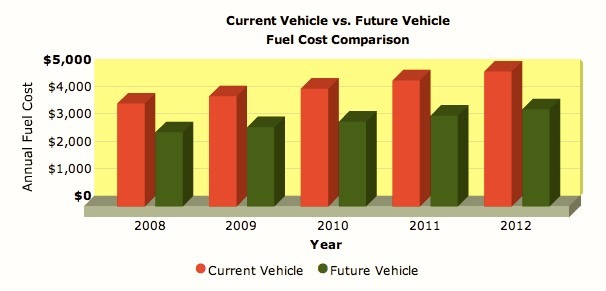
| Year | Fuel PPG | Current Vehicle Cost (18mpg) |
Future Vehicle Cost (25mpg) |
Approximate Savings |
|---|---|---|---|---|
| 2008 | $4.51 | $3,758.33 | $2,706.00 | $1,052.33 |
| 2009 | $4.83 | $4,021.42 | $2,895.42 | $1,126.00 |
| 2010 | $5.16 | $4,302.92 | $3,098.10 | $1,204.82 |
| 2011 | $5.52 | $4,604.12 | $3,314.97 | $1,289.15 |
| 2012 | $5.91 | $4,926.41 | $3,547.01 | $1,379.39 |
| 5-year Totals | $21,613.19 | $15,561.50 | $6,051.69 | |
Expect to see greater savings if gas costs increase more sharply or the family ends up driving more than 15,000 miles in a year.
Examples like this may inspire you to think about fuel efficiency the next time you go car shopping.
The MPG Illusion
But before you start writing your checks to the dealer for that new hybrid (or compact), here’s something you need to know about gas efficiency in so many words:
Equal increases in MPG are not equal in gas savings.
This truism highlights a very interesting concept called “The Illusion of Miles Per Gallon”, which challenges our understanding of how fuel efficiency is determined and questions whether our choices in cars (when based on gas use) are actually on the money (pun intended).
Here’s a snap quiz from the NY Times that illustrates this concept:
Which of the following would save more fuel?
a) Switch a compact car that gets 34 miles a gallon with a hybrid that gets 54 MPG.
b) Switch an S.U.V. that gets 18 MPG with a sedan that gets 28 MPG.
c) Both changes save the same amount of fuel.The correct answer is b. Going from 18 m.p.g. to 28 m.p.g. will save you more fuel than going from 34 m.p.g. to 54 m.p.g. (198 gallons vs. 109 gallons).
A couple of professors ran a series of experiments to show that the current standard of miles per gallon leads consumers to believe that fuel consumption is reduced at an even rate as efficiency improves. But that’s not the case.
“Miles per gallon is misleading and can play tricks on our intuitions,” quoth the professors.
So the miles per gallon comparisons can throw us off. By using this metric, many people somehow make a direct comparison between the miles per gallon numbers; they note the discrepancy (or percentage difference) and assume that those comparisons producing the largest mpg differences will automatically lead to the bigger cost savings. This line of thinking was quite evident in the results of a few studies made, where participants where asked to rank savings in fuel based on MPG comparisons (much like the quiz above). The results were fairly surprising: only one in 77 participants who took the MPG test got it right!
Many people look at a 50 percent mpg improvement, such as 33 to 50 mpg, and assume that it will save more gas than a 30 percent mpg improvement from 10 to 13 mpg over the same distance. A quick check of the math will show that 10 to 13 saves 230 gallons over 10,000 miles; 33 to 50 mpg saves only 100 gallons over the same distance.
Another common tendency is for people to overvalue the larger mpg measurement differentials between efficient cars while undervaluing the smaller mpg improvements between inefficient cars. This is what is described as the “MPG Illusion”.
The Math Behind Miles Per Gallon Comparisons
So let’s go back to the example above and look carefully at the calculations behind the fuel consumption between the compact car vs hybrid, and the S.U.V. vs the sedan:
Which saves you more gas?
a) Switch a compact car that gets 34 miles a gallon with a hybrid that gets 54 m.p.g.
b) Switch an S.U.V. that gets 18 m.p.g. with a sedan that gets 28 m.p.g.
Answer:
| Driving Distance | Case (a) | Case (b) | Conclusion |
|---|---|---|---|
| Drive 10,000 miles (typical distance driven in a year). |
10,000 miles / 54 MPG uses 185.2 gallons. 10,000 miles / 34 MPG uses 294.1 gallons. Gas Savings: 294.1 – 185.2 = 108.9 gallons. Replacing a 34 MPG car with a 54 MPG car saves you 108.9 gallons of gas every 10,000 miles. |
10,000 miles / 28 MPG uses 357.1 gallons. 10,000 miles / 18 MPG uses 555.5 gallons. Gas Savings: 555.5 – 357.1 = 198.4 gallons. Replacing an 18 MPG car with a 28 MPG car saves you 198.4 gallons of gas every 10,000 miles. |
198.4 gallons saved in Case (b) is greater than the 108.9 gallons saved in Case (a). |
By expressing the numbers in gallons per miles (GPM), we’re able to get a much more accurate picture of fuel efficiency. These printable reference tables showing MPG to GPM translations were prepared by the professors behind the MPG Illusion to help you with your car shopping process. I’ve also reprinted them below for your convenience.
Gas Savings From Equal Improvements in MPG
This table shows the gallons of fuel needed to drive 100 or 10,000 miles at varying rates of fuel efficiency.
| Miles Per Gallon | Gallons Consumer Per 100 Miles | Gallons Consumed Per 10,000 Miles |
|---|---|---|
| 10 | 10 | 1,000 |
| 15 | 6.67 | 667 |
| 20 | 5 | 500 |
| 25 | 4 | 400 |
| 30 | 3.33 | 333 |
| 35 | 2.86 | 286 |
| 40 | 2.50 | 250 |
| 45 | 2.22 | 222 |
| 50 | 2 | 200 |
Incremental improvements at the lower end of the range result in much greater fuel savings than the same incremental improvements at the higher end of the range.
MPG Improvements that Save Equal Amounts Of Gas
Compare how many gallons are actually consumed over the same distance by various cars running at different MPGs. The MPG column entries don’t increase linearly while the GPM column entries do. This means that if you replace a car which runs at 10 MPG with one that runs at 11 MPG, you’ll save the same amount of gas as compared to shifting from a car with a 33 MPG rating to one with a 50 MPG rating!
| Miles Per Gallon | Gallons Consumer Per 100 Miles | Gallons Consumed Per 10,000 Miles |
|---|---|---|
| 10 | 10 | 1,000 |
| 11 | 9 | 900 |
| 12.5 | 8 | 800 |
| 14 | 7 | 700 |
| 16.5 | 6 | 600 |
| 20 | 5 | 500 |
| 25 | 4 | 400 |
| 33 | 3 | 300 |
| 50 | 2 | 200 |
A Proposed Solution To Clear Up The MPG Illusion
The researchers who provided this interesting study on the MPG illusion has since provided strong recommendations that may help dispel the confusion of the public. If car manufacturers provided a different sort of metric to relay fuel efficiency — one which lent itself to direct comparisons — then maybe we’d make more accurate decisions.
The proposed solution? Supplement the MPG (miles per gallon) metric with GPM (gallons per mile). As Rick Larrick of MPGIllusion.com states:
Direct comparisons of MPG is what leads to illusions. In each case, you have to convert MPG to a GPM measure to know the amount of gas used. Both MPG and GPM have a useful role at different points in owning a car. MPG is useful when you’re driving a car. GPM is useful when you’re purchasing a car — it better captures the fuel consumption, and fuel savings, when comparing a current car to a new car, or when comparing two new cars to each other.
The Bottom-Line
The biggest takeaway here for me is that the largest impact consumers can make to save on fuel is by replacing the most inefficient cars. Based on the MPG illusion discussion, we’d do more for our pocketbook and our environment by swapping out the worst gas guzzlers with slightly more efficient models, than by replacing a Honda Accord with a hybrid.
So if you’re looking to buy a new car, it’s good to know that even an incremental improvement in efficiency can make quite a difference — not just to your bank account, but also to the environment. Plus imagine your satisfaction knowing that your decisions favoring efficient vehicles will stick it to those greedy gas suppliers. 😉
Suggested Readings:
Hankering for more analysis? Then read more about the MPG Illusion in these superb resources:
- Why We Misunderstand The Meaning of MPG: published by the authors of the MPG Illusion.
- The MPG Illusion page.
- Test your MPG knowledge with this interactive quiz!
Copyright © 2008 The Digerati Life. All Rights Reserved.

{ 52 comments… read them below or add one }
I feel like this is just confusing the situation. An average consumer isn’t going to sit there and think “If I upgrade to this car, will it save more money than if my neighbor upgrades to this other car?” They’re going to think about their own situation, “should I upgrade to car A or car B?” The base case will nearly always be the same.
In the example done above, let’s see what happens when the person upgrades from the 18 mpg SUV to the hybrid that gets 54…
10,000 miles / 54 MPG uses 185.2 gallons.
10,000 miles / 18 MPG uses 555.5 gallons.
Gas Savings: 555.5 – 185.2 = 370.3 gallons.
Replacing an 18 MPG car with a 54 MPG car saves you 370.3 gallons of gas every 10,000 miles or $1,481.20 over the course of the year
It’d be more cost effective to upgrade from the 18MPG to the 54MPG car for that person.
I agree, there may have been many more variables in the scenarios expressed in my article above.
In reality though, I’m not entirely sure that people will be committed to making drastic changes in their buying patterns… How likely is it for consumers to swap a car that uses 18 MPG with one running on 54 MPG? It’s like deciding on trading in your truck for a compact hybrid. Seems to me that it may be less likely a switch that someone will do. But I may be wrong…
Hence, I thought that by showing some math that proves that small changes may be worth someone’s efforts (or sacrifice), then it may change a few minds… 😉
I guess the point here is that by seeing a few examples, it’s interesting to see comparisons across the board. And by making even small changes — say by switching from 10 MPG to 13 MPG, you’ll save even more on gas compared to switching from 33 MPG to 50 MPG.
I also thought that the math lovers out there may have wanted a fun quiz to work with.
Something else to consider is the actual trade in value on your car/truck/SUV. A lot of the values are lower than the blue book right now because of the gas prices.
Phil,
I think you’re forgetting one major issue when you say that the switch to the hybrid would be more “cost effective”. Using your numbers and the numbers from the article:
*assumptions: 10K miles, cost of gas $4/gallon
SUV->Hybrid: 370.3 gallons or $1,481.20
SUV->Slightly more efficient: 198.4 gallons or $793.6
So, yes, the switch to the hybrid saves more, but it only saves $687.6
If you assume that the “average” driver will drive for 15K miles in a year, and the hybrid runs only $5K more (I imagine it would actually be more), then it will take that person 6.9** years for the total cost to be the same as when they bought the non-hybrid (less expensive, and less efficient) vehicle.
$687.6/10K miles = $721.98/15K miles
15K miles = 1 year
5000/721.98 = 6.9254
**It will take less time to reach as gas prices go up, but we are also not including the interest paid on that extra $5K or the difference on what that extra $5K would be worth if it were invested (even in a high yield savings account)
I wish more people took the actual savings into account when buying a new, more efficient car. Some people in SoCal are paying $40,000 for a Prius (that’s a $14,000 premium over the actual price.) It will take at least 10 years to start seeing any savings from that.
I think it’s about percentages; a 10 MPG car being replaced with a 15 MPG car will save as much as replacing a 33 MPG with a 50 MPG car. Both are increasing 150%.
I’m assuming the point of the article was to show that it was more important for people with low MPG vehicles to increase them, even if they only gain a few more MPGs over the original? Because they gain a greater percentage per Mile Per Gallon than when the MPGs get higher?
I am seeing more real estate agents getting hybrids. I hope to get one soon myself
Great post! As a math nerd I enjoyed this a lot. And to “Phil,” look at the chart again. It says 10 to 11 is the same as 33 to 50. Wowzers!
I’m perfectly happy with our 02 Honda Civic, and hopefully we’ll keep it for a looonnnnggg time.
Vespas for me and the wife…nearly 100MPG we strap the kids on ala mainland China with bungie cables and wire.
All kidding aside. It does make sense to get the right kind of car type, then get the most fuel efficent. Me…I am holding out for the BTTF DeLorean with the Mr Fusion add-on!
@Phil, yes the point was that small incremental changes in MPG may have a bigger (or equivalent impact) than larger incremental changes. Most people are surprised that this is the case!
Many people think that to save gas they’d have to buy a hybrid. But all they really have to do is drive a more efficient model than their gas guzzling model.
Along these lines, I think a lot of gas savings will come from the ~10MPG vehicles passing from those who drive more to those who drive less. Not just more efficient vehicles, but also more efficient distribution of drivers to vehicles.
Excellent expansion on the NYT, BTW…
This article must be a reflection of the “new math”—I’m sorry, in the real world one asks what will this cost me to run—-if I was getting 18MPG, and the new vehicle promises me 25mpg. I KNOW the new vehicle will save me money, the vehicle that promises me 54MPG will save me even more—-all the blather about MPG versus GPM —is just razzle dazzle dumb.
Gary,
I guess you’re stating the obvious, any car that has a higher MPG will always save you more money. It may seem like this is much ado about nothing. But I disagree that this is the “new math”, it’s just basic math that doesn’t seem as basic when you first see it.
I believe that a lot of us are usually stuck to our habits and find change to be challenging. I don’t even want to give up my family van — it’s one of the most practical things I own. So I tend to think “why bother to change?” A 2 MPG difference won’t do much anyway, so I’m sticking to my old choices. Well, this math has shown me that even that 2 MPG can be a big difference (in some scenarios) so it’s something I’ll take into account when I purchase a new vehicle.
There’s so much to consider when buying those fuel efficient cars too — for example, the actual expense of buying one can stop you on your tracks. So any little bit of information helps to clarify what it means to “buy into” fuel efficiency.
I’m behind the GPM bandwagon — anything to clarify how much we’re truly saving on fuel and money, plus it’ll tell you if it’s worth buying a fuel efficient car (e.g. a hybrid or electrical car) that happens to have a much higher initial cost than most other vehicles.
Thanks for posting this, it’s been something that I’ve tried to explain to people for a while now.
Phil – your statement “I think it’s about percentages; a 10 MPG car being replaced with a 15 MPG car will save as much as replacing a 33 MPG with a 50 MPG car. Both are increasing 150%” is exactly what this article was explaining is an incorrect line of thinking. They do NOT save as much.
The fuel efficiency increases by 50% each, however if driven for 10k miles a year, the 10 –> 15mpg car will save 333 gallons, the 33 –> 50mpg car will save 100 gallons.
While I fully support improving fuel efficiency across the board on all vehicles, you get the biggest bang for the buck with small improvements to the efficiency of the least efficient vehicles.
Rather than a GPM figure, I’d push for a “GPY” (gallons per year) based on say 15k miles/year. This will give consumers a straight forward and easy way to compare what they’re really looking for, which is the relative fuel cost of operating a vehicle.
And to Gary – this isn’t “new math.” It’s just regular old math that not many people do when they buy a car.
Great article! I had to think about this one for a while. Being in a math job field, I tried it out on a few of my co-workers, and none of them believed it until they ran the numbers for themselves!
interesting, if you’re comparing buying car a to car b, but doesn’t reflect true costs if your choice is to keep big car SUV or trade in small small fuel efficient car (as indicated by the word ‘swap’ ion your blog post.
For that you’d need to figure out trade in values and lifespans of the cars.
If you think you’re actually going to save $6+k, over 5 years you may be disappointed as that savings will most likely be eaten up by the cost of your newer car.
@Curtis,
True, the savings on a fuel efficient car (for $6,000+) do not take into consideration the premium you may end up spending to buy that car in the first place. Nevertheless, the calculations I provide give you a way to compare savings you get vs cost of the new car. It should be a starting point when you’re shopping for a new car.
I agree you should take into consideration lifespans and trade in values when you’re shopping.
I think that the fuel economy contribution to the total cost of the car needs to be balanced out against other cost such as servicing, insurance etc, as the could be significant.
For example, I have owned a diesel 4X4 for a number of years. I bought it hoping that it be more economical to run when compared to a similar petrol 4×4. However, it ended up cost more due to its short servicing period. It need to be serviced every 5000Km where as the petrol was only serviced every 15000Km. So the servicing cost was 3 times more.
You’re looking at total savings in relation to total miles driven instead of total savings in relation to mpg. True, an increase from 1 to 2 mpg will provide the largest ABSOLUTE reduction in fuel consumption, the ratio is the same as going from 2 to 4. This is a case of using statistics to lie.
From your example:
10,000 miles / 54 MPG uses 185.2 gallons.
10,000 miles / 34 MPG uses 294.1 gallons.
Gas Savings: 294.1 – 185.2 = 108.9 gallons. You then divide 108.9/294.1 to find the percentage of savings which is 37.02%.
10,000 miles / 28 MPG uses 357.1 gallons.
10,000 miles / 18 MPG uses 555.5 gallons.
Gas Savings: 555.5 – 357.1 = 198.4 gallons. You then divide 198.4/555.5 to find the percentage of savings which is 35.7%.
And what do you know, going from 34mpg to 54mpg actually saves you more in relation to what you were spending before!
The way your article is written, it would be like saying that more people die of starvation in the US today because 10,000,000 people die of starvation in the US, but there are 300 million people, and 10 years ago there 9,000,000 people who died of Starvation and there were 250 million people in the US. The ratios 10,000,000/300 million = 3.3% die of starvation today. 9,000,000/250 million = 3.6%. Sure more people might die of starvation today in ABSOLUTE numbers, but the ratio of people who starve is less. This would mean that fewer people are starving but MORE people are not.
Your article is misrepresenting the facts. Numbers dont lie, but people dont know how to use numbers correctly which is a massive problem.
Matt – I love your last line!
I think there’s two key things to take away from here. If you’re buying a new car, the application of the math is simple and people in general can weigh the cost/benefit of different vehicles with different fuel efficiencies.
In terms of a general national energy policy however, the greatest reduction in transportation related fuel use comes from making small improvements to low efficiency vehicles.
25MPG?! WHAT A F***ING JOKE, It is nearly impossible to find an SUV with less than 30MPG in Europe, Estates (Station Wagons) are more towards the 45MPG range and some hatchbacks get 90MPG no problem. So just try getting European cars, they’re cheaper, they’re safer, and they can actually go round corners! You simply can’t lose.
It bears turning this around and looking at it the other way. If drivers of ultra bad mileage vehicles benefit so much from a tiny incremental increase in mileage that they also suffer just as starkly from bad driving behavior. I see so many pickups that roar away from stops and come screaming up behind my car at lights. These morons, by your chart, are costing themselves a fortune by decreasing their mileage a mere mpg or 2. By contrast, if I’m impatient and get 47 with my prius instead of 53 or even 57 (under my most obsessive pulse-and-glide experiments) then what’s the difference? I might as well drive like a maniac and enjoy myself, since it doesn’t matter.
Well, actually, when I want to save fuel, I hop on my bike anyway. Why even start up the car, even a high-mileage one?
there are the same problemes in germany too.
I don’t agree with Matt Jones. European cars aren’t cheaper, they are more expensive.
As to the subject, I think the best way to save money on fuel and to benefit environment is to switch to 100% electric cars. There are some out there, but expensive. One of the best I’ve ever heard of it Tesla Roadster. Tesla Motors also plans to manufacture White Star, which will be competition to BMW 5 series.
I wonder how a start up business managed to manufacture 100% electric vehicles with excellent technical features and automobile giants like General Motors or Toyota are still playing with hybrids. Or may be they’re playing with us trying to convince an average consumer that electric car is science fiction?
Does anyone here know about hydro cars? and how it works? they said that it can be the best alternative for fuels.
Ed: The whole thing about running your car on water doesn’t work. I think it’s a scam.
I am noticing a big trend at used car lots in my area to really promote cars that have good gas mileage. I haven’t actually seen any hydro cars lately though, so that whole water for gas thing is pretty much not legit.
Great article – it is true that MPG can be a misleading way of talking about fuel efficiency, and becomes much less meaningful when talking about multi-occupant commuter vehicles – I would rather ride in a bus that gets 10mpg and carries 40 people than a car that gets 50mpg that carries just myself – while the bus is burning more fuel, it’s carrying 40 times the number of people – so if you break it down per person, you’re burning a whole lot less gas on that bus than in your hybrid.
With fuel prices rising with no end in sight, both consumers and automobile companies have become more and more concerned with fuel-consumption. While drivers attempt to cut down their gasoline usage, automobile companies are researching and producing more fuel-efficient cars, some to come out as early as next year.
Very interesting to see the numbers of how much you would save. I don’t think that I drive more than 10k a year and I drive in a small Honda. I think I am saving quite a bit of dough over those that choose to drive something big just for themselves. Thanks for sharing this, it was interesting.
Great article. I just came across this and I’m amazed at the MPG comparisons and how they differ. The math is still a bit, erk, in my head but I’ll flush it out to get a better understanding of this.
This is a must read for anyone using the MPG as a comparison tool when comparing 2 distinct cars.
These fuel efficient hybrids may end up having more costly problems and generally more cost down the road than say a fuel efficient gas engine or diesel.
Very informative articles and statistics on MPG consumption. Certainly increases knowledge about gas saving.
Nice article. With soaring fuel prices all the consumers have become increasingly concerned.
Your very correct. You would have to drive a hybrid 80k miles to break even if you bought the base (non-hybrid) model. Its more of the thought that counts! Wait we are saving the environment…not really because making the nickel hydride batteries for the Prius is very damaging to the Earth!
Good points being made about MPG. You really have to do your research before buying a Hybrid.
I have to put gas in a lot of cars every week and it is so expensive. But, it is great when it is a better mileage vehicle. I even tend to drive the cheaper ones myself.
Thank you for your research. It has definitely help me in deciding which car to buy for long term economical investment and not forgetting taking care of Mother Earth.
My car is my dream machine. I take great interest in maintaining it in a way that it gives me good mileage and runs smoothly. I can find many people here who are very possessive about their cars …. Nice blog… Keep posting.
Looks like there’s a lot to be saved by making our TRUCKS more efficient. Yet…all the focus is on our compact cars.
Another important thing to keep in mind is that buying a hybrid isn’t always about just saving money. Simply because a lot of the time, you aren’t. For example, the difference between a Chevy Tahoe and Chevy Tahoe hybrid is around $13,000. That could buy 3,250 gallons of gasoline at $4.00 dollars per gallon.
I think the majority of people buy hybrids because of the image and they want to help out the environment.
Hi,
This is a good and important read as fuel efficient cars will become needed not too long from now if we want to keep this world alive!
Regards
Dan
Did anyone hear about the Chevy Volt 230 MPG being reduced. Not sure why exactly and the new figure is not available but it is expected to be lower.
For consumers to swap a car that uses 18 MPG with one running on 54 MPG? It’s like deciding on trading in your truck for a compact hybrid.
It really depends on what you need, if you don’t ‘need’ a big truck, get something smaller and save a lot of money. I have a smallish diesel car which is more than suitable for myself, wife and son. On average it does 55 mpg.
This is so confusing. I do not think the average consumer cares. Even the ones that care about the environment also have so many other factors that contribute to their car choices – style, comfort, price, social expectations, etc… that this type of distinction is likely to be lost on all but the most ardent environmentalists.
It’s a hard choice. I think a lot of people think driving a diesel will save them money but sadly diesels are more expensive to service and repair and generally less reliable in my opinion.
Why aren’t the auto industries introducing cars in the common market that runs on other resources that are naturally and easily available than fuel?
Have any good links about electric cars? I think that is our best option. Even more so than Hydrogen. Why? Even though hydrogen is clean, it can be controlled by the supplier.
I found this article really interesting because I was just having this discussion with someone. I’m debating between buying two cars: one is a 2011 Mazda 3 with 1,400 miles making 24 mpg city/ 33 mpg highway and the other is a 2011 Honda Civic with 12,000 miles on it and 25mpg city/36mpg highway.
From doing the math for the 3 mpg difference:
10,000/36mpg = 277.77 GPM
10,000/33mpg = 303.03 GPM
303.03-277.77= 25.26 gallon difference in a year’s worth of driving an average 10,000/year.
If gas costs at best in my area $3.19, that’s roughly an $80 difference just taking into account mpg. Is this correct? Am I understanding how this works properly?
I was strongly at first considering the Honda since I saw that it makes more miles for the gallon but the Mazda is $1000 cheaper for me and only has 1,400 miles on it. Mazda would be the better choice here, no?
Thanks so much for all of your help! 🙂
Hi Christine,
My gut feel is in accordance with yours. I would consider the starting point here — the almost new Mazda with only 1,400 miles on it vs the Civic with more miles. But as I’ve mentioned — we should take into consideration all the factors involved with the purchase, including starting cost, durability of the car itself and maybe even resale value. But if you were to make the argument for fuel efficiency between these 2 choices, I don’t think it’s as big a factor here as you may have first thought.
Thank you so much for your response! It is really much appreciated! 🙂
You’re welcome Christine! Good luck and enjoy the new car!