A rising tide lifts all boats.
There was a time when the Bay Area was subject to that proverbial rising tide, where easy money chased opportunities and opportunities minted even more money. During the tech boom of the previous decade, the rich got richer, the less rich got a bit richer, and most everyone was doing well. Little did we know how much this would be contributing to our ever escalating cost of living, whose effects we keenly feel today.
After the bubble burst in 2003, things have gone the other way somewhat. There’s still a lot of money floating around, but it’s cautious money, and distributed a bit differently. I just read an article in the San Jose Mercury News that brings up a concerning trend. Is there something really happening to our local middle class?
Reported data seems to show that our middle class is shrinking ever so gradually. The bigger question I have is this: how reflective is this of what is happening elsewhere around the nation? And is this something we should care about?
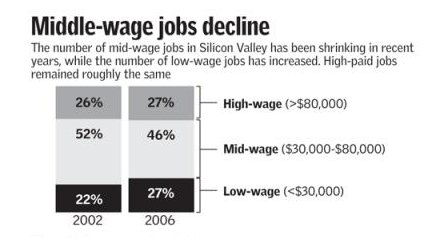
More interestingly, who is doing something about this?
Tuition Break For The Working Class
Well some out there care enough to do something about it. Some influential institutions out there are taking steps to address the typical costs that plague everyday working families. For instance, that Stanford University has announced free attendance for kids whose families earn less than $100,000 has given me some assurance. This is a way to ensure that upward mobility remains alive and well, even as the middle class is feeling the squeeze from high cost of living, crazy property values and seemingly diminishing mid-level jobs. Such a move will make a positive impact to some middle class wallets, given that a third of Stanford families earn below $100,000 annually.
Cost of Higher Education
| STANFORD | UC-BERKELEY | SAN JOSE STATE UNIVERSITY | |
|---|---|---|---|
| Annual costs | $49,363 | $25,308 | $18,195 |
| Expected contribution from a family with $150,000 income | Sliding scale (up to $49,363) | $25,308 | $18,195 |
| For a family with $100,000 income | $11,000 | $22,179 | $18,195 |
| For a family with $55,000 income | 0 | $3,871 | $3,871 |
“The elimination of loans is also a good thing, but one that merely catches us up to Princeton and Harvard,” said Hyde, from Potomac, Maryland. “And the continued consideration of home equity is problematic. I know of students whose parents refinanced their houses to continue to afford tuition.”
Throughout the nation, top schools have been seeking ways to end tuition anxiety. Until recently, top colleges offered little or no aid to average families.
Three years ago, Harvard waived all costs for families earning less than $40,000 per year. A year later, Stanford and Yale followed suit for all families making up to $45,000.
In December, Harvard declared a plan to cut costs for families earning under $180,000. Harvard families earning $120,000 to $180,000 pay no more than 10 percent of their income toward college. At Princeton, families who make $120,000 to 180,000 contribute 16 percent of their income, on average, toward school.
Swarthmore, the University of Pennsylvania and a growing number of other schools are also jumping on the no-loan bandwagon.
Wonderful as it is, I still consider this break that Stanford affords as some kind of a lottery. The catch is that your child needs to have an impressive academic record (and lots more feathers under your cap) to be part of the diverse lucky few who fit the profile for skipping out on tuition this way. It’s tough enough to get into Stanford, but even tougher for those who’ll grapple over the few spots that they’re giving away for free. It may not be enough that you make less than $100,000 (lots of people here are in this boat), and have a kid who’s brilliant. There are too many other factors that figure into their admissions calculation.
But, it’s good to know that the Ivy Leagues are recognizing the middle class pinch and are addressing them in some capacity, and helping to level the playing field for those smart and ambitious folks who are aspiring to acquire a top education and highly coveted diploma.
Still, I continue to wonder how much this’ll influence larger socio-economic trends. Or is it just the case that we’re simply waiting for the next tide to come by to lift us up again?
Image Credit: ABC News; Data Source: San Jose Mercury News
Copyright © 2008 The Digerati Life. All Rights Reserved.

{ 22 comments… read them below or add one }
I’m also located here in the Valley (San Jose, to be precise.) What I’m seeing is tons of companies moving out the middle-wage earners. Two of my friends have gotten paid to move their jobs to the Denver area. One is a high-wage earner, but the other (whose entire department was “insourced” to Denver) was a middle-class earner. The tech companies are coming here to recruit high-end engineering and development talent, but most of the other company functions (tech support, accounting) are much cheaper to do elsewhere. Hence this strange dichotomy. I would only expect this to get worse as the years go on. Companies can’t afford to pay high salaries here for people they can find elsewhere for less.
I wonder if they indexed this for inflation? If not the news is worse!
I guess the bubble has burst!
I think it’s definitely something for us to worry about nation wide. I heard this about 2 years ago from a friend of mine and have heard it a few times out of some of our Presidential contenders.
I think a major reason is because of the many jobs going overseas. IMO we need to give small businesses and self starters a little more incentive. Big companies can’t compete on a global scale w/o outsourcing but if we created more business owners we could help out the middle class.
It’s one thing that helps us be a great nation. Without the middle class we’re no longer a nation of opportunity.
Honestly I think the problem lies more in the complete and utter unaccountability of state universities. They have many unnecessary profs, overpaid profs with tenure, and ridiculous spending budgets: all while getting tax dollars and passing on the extra buck to students. Its almost unbelievable.
The Canadian university system seems more affordable. Albeit, tuition increases are fast and steady. More and more students are taking on massive debt in order to get educated. The challenge is paying off that mountain of debt upon graduation. I managed to get unscathed in my first degree by graduating with zero student debt (mostly due to scholarships and working part-time). I wasn’t so lucky in my second degree as I graduated with 17K in debt. It’s terrible to be a young graduate and start a new chapter in one’s life with crushing debt.
I am a firm believer that where there’s a will, there’s a way. I paid for college myself to the tune of 30k. Yes, I walked out of there with a huge debt, but also a big sense of accomplishment and a feeling that I could do anything. That same feeling stays with me today and has led to my success (well, that and being frugal! 🙂 ). Regardless of circumstances, those who want to succeed find a way to do it. Should college be affordable? Certainly. But what is affordable is often very subjective.
@Jesse: Yes, the problem is those state university college professors with their bloated $20,000 salaries and their tenure earned after years and years of schooling, teaching, serving as gophers for full professors and having ZERO job security. That’s it.
I think the private school’s motivations are good, and it’s a nice thing to do. But you know what? It says that – again – who your parents are matters more than who you, the student, are. Why not make tuition free for all students? Let those mega endowments pay for all the students! Drum a sense of obligation to return donations to the schools once you’ve MADE it. Why not? Isn’t a Harvard education “worth” it? I agree that this probably just means that poor kids have one more hurdle to climb in getting admitted.
These free tuition articles make me sick to my stomach. The university I attended instituted a free tuition for “lower class people” about 3 years after my graduation. My education left me with over $60k in debt, and that’s AFTER a very generous scholarship. That’s just the way it goes when your parents make a combined 40-50k and you want to attend one of the best schools in the country.
Given their criteria for getting the free money, I would definitely have qualified to go for free now.
I consider myself to be very fortunate that the Northern California universities are instituting these changes. I need to apply for grad school this year and had basically ruled out moving up north for school. I was contemplating just continuing grad school at a CSU and then transferring to a better school for Ph.D. Now the doors are open for me to go to Berkeley which has always been a dream.
If only the schools in So Cal took a page from Stanford and Berkeley. (Hint, hint USC)
Brip Blap, come on now: $20,000 salaries? Maybe grad students but tenured profs?
Oh but wait!
US Department of Labor, Bureau of Labor Statistics:
“…Earnings for college faculty vary according to rank and type of institution, geographic area, and field. According to a 2004-05 survey by the American Association of University Professors, salaries for full-time faculty averaged $68,505. By rank, the average was $91,548 for professors”
For completely unaccountability, yeah rough gig. Anything that high paying that has no accountability and is government funded is pure looting.
While my dad made too much, Micah could have probably gone for free to most of these schools (at least as an undergrad). And then we wouldn’t have nearly as much debt. On the other hand, maybe I wouldn’t having this blog either…always a bright side.
middle class is shrinking, but shouldn’t we be more concerned about the fact that the lower class increased. 5 percent from the middle class went down and only 1 percent went up.
@jesse: Tenured profs, no, but do you know how many professors make $98,000 per year pre-tenure? The numbers you cite don’t make any distinctions between public and private schools, either. I suspect there are a lot of professors at Harvard who make more than professors at Kentucky. Statistics can show what they want, but the simple fact is that most professors – particularly in technical fields – would make far more in the private sector. Tenure is one of the carrots offered them to stay in teaching.
And complete unaccountability? Do you think tenure’s just given out as a party prize as people walk in the door? You have to put out years of hard work and dedication to earn tenure, and it’s not as if every professor automatically gets it.
You know who is completely unaccountable and has government funding? Bear Stearns’ chairman. His government handout to save his firm, grant him his payout and coast off into the sunset are complete unaccountability.
I’m sorry, but saying that college professors are The Problem is an exaggeration.
Higher education is a business. Educational institutions do not make more financial aid available because they are trying to “help out” the middle class and address some pinch. If they wanted to be charitable, they’d just cut internal costs, cut tuition, pay salaries out of the endowment, etc.
They are doing this because there is cutthroat competition for the best students and they are collectively willing to do what it takes to keep their industry elite, i.e. something that everyone wants but not everyone can have. The actions the Ivy League, et al. have taken indicate to me that they have projected declining applications and want to do everything they can to stave off a bear market in the education industry.
Ivy League education is a business, a 5-star service like the hotel business. They perceive that they have a lot of power, and will do what it takes to retain power. Offering free tuition for some has benefits:
* applications rise, the school stays elite
* the nominal tuition costs can remain high for “those who can pay”
Steve,
Yes of course, universities do want to be more competitive. But I also think there is no shortage of brilliant applicants who can afford getting into universities. I have relatives who work as college and graduate professors (actually at Stanford) who tell me that they’ve had to turn away many highly eligible applicants because of the limited space. 1 in 6 get in.
That’s the case even without the free tuition offers.
Wow. I was unaware that ANY university was actually attempting to help assuage tuition anxiety. At this point, I assume not many qualify/get accepted, but it is an encouraging trend.
What a great move by Stanford. Thats the kind of thinking we need to help people get ahead in life. Berkeley and San Jose don’t have too bad costs as well though, not much for the quality of education your getting. If only all the universities took this kind of action.
I’ve been wanting to go back to school forever here. I am 26 with a 2 yr. old and can’t afford it. I pray you can give me some helpful hints on how it can be affordable for a woman with a minimum income wanting to do better; if you can give me a way to do this for free, I’d be extremely grateful… God Bless.
I completely see what you’re saying with the whole “lottery” concept. It’s just too hard to predict..
Universities should cut down their fees for academic studies. I agree with the fact that if i am a young graduate with $20K debt on me for my studies how much can i get success? i appreciate the fact that Colleges are now slashing their fees. I am hoping the same from the boys military school that I am attending.
I need to study in Germany. I’m very very much interested in German studies! I truly deserve to get a student visa for Germany — for business course studies.