What do you expect from your credit card? Whether you’re after rewards or just the convenience of using a card with great credit management features, Chase has come up with specific cards that fit the bill. The following card trifecta represents some of the most recognizable brands from Chase that provide attractive benefits.
Chase Freedom Credit Card

My #1 requirement for a credit card is that it has NO annual fees. I pay my credit card bills in full each month, so I’m most interested in credit cards with rewards programs, and in particular, cash back cards that have NO fees. On that note, I’ve decided to be proactive and discuss the Chase Freedom card, which fits these requirements. Chase’s flagship card actually comes in a few versions, thanks to several ongoing promos that the issuer likes to run. We’ll look at a few of them here, such as the Chase Freedom MasterCard with $100 Cash Back and Chase Freedom Visa with $100 Cash Back Bonus.
Let’s talk about which aspects of this card are the same across all its versions:
Initial Bonus. The Chase Freedom Card is a cash back rewards card with very generous features compared to other cards that promise rewards. Each version offers an initial cash bonus, which is typically balanced out against its other features. A higher initial cash reward will normally mean a shorter bonus intro APR offer, since this card typically offers a combined reward and 0% APR offer.
Regular Rewards. You’ll also earn 5% cash back on certain popular, rotating categories like gas, home improvement, dining, department stores, travel (airfare and hotel), if you’re eligible. These categories are updated per quarter, so make sure you are enrolled in the rewards program at all times. And if you shop online through Chase’s Ultimate Rewards Mall, you might find yourself earning as much as 10% to 20% cash back at select retailers and merchants.
You’ll earn a full 1% cash back on every purchase you make, wherever you use any of these cards. Although there are some exclusions on what items you can earn cash back from — such as cash advances, balance transfers, and travelers checks — you’ll be able to earn rewards for purchases online and at the brick and mortar stores you already visit. There are NO limits on how much cash back you can earn, which also has no expiration date. There are NO spending caps or tiers either.
0% Intro APR & No Fees. Better still is the lack of an annual fee. Now depending on which Chase Freedom card you select, you can get a 0% APR on pertinent transactions for a preliminary period that lasts several billing cycles (if you qualify). For those card variants with a 0% rate attached, the card’s regular rates kick in after the intro period. Note that your credit history is assessed to check your standing as a potential customer.
Security. If you find unauthorized purchases on your account, there’s Zero Liability. So if a thief lifts your card and helps themselves to a shopping spree, you won’t be the one paying for it. Just be aware that ATM transactions and PIN transactions that aren’t processed by MasterCard or Visa aren’t covered by the Zero Liability policy.
While the Freedom card contains all the great features we’ve mentioned earlier, each flavor of this card contains distinguishing characteristics and features. You can apply for any one of these variants once you’ve determined which one has the terms you are seeking.
| Chase Freedom Version |
Terms & Features | Sign Up |
| Freedom Visa: $100 Cash Back | Receive $100 cash back after you make $500 in purchases over 3 months. Also get 0% Intro APR for 15 months on new purchases & balance transfers. Best for customers who have a modest balance they want to get rid of. |  |
| Freedom MasterCard: $100 Cash Back | Same features as the Freedom Visa with $100 Cash Back. This card won the “Best Overall Card” (CBS MoneyWatch 2011). | |
Chase Sapphire with Ultimate Rewards

While Chase Freedom is Chase’s primary cash back card, Chase Sapphire is one that promises general rewards via points. It’s geared a bit more towards travel expenditures but you can earn rewards that can be redeemed for a variety of merchandise, experiences as well as cash. As a typical Chase card, you can expect a healthy initial reward bonus as well — in this case, it’s 10,000 points (equivalent to $100) once you’ve spent $500 in 3 months. Just like Freedom, you’ll earn points for eligible transactions and you’ll accumulate more if you use the Ultimate Rewards Mall. Kick things up even further by using Chase’s proprietary Travel Booking Tool to help you rack in double points for tickets that you book.
If you like the flexibility of a general rewards no annual fee card, then Chase Sapphire may be more preferable than the Freedom card, since cash is just one of the items you can exchange for your points. You’ll also get additional travel benefits such as trip cancellation insurance, travel and emergency services, and travel accident insurance. This card also comes with a few other features such as no preset spending limit, a choice of your payment due date and if you qualify, the Blueprint payment program. You can easily ask for additional cards.
Chase Slate with BluePrint
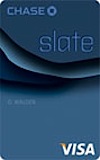
Now we come to a card with a different orientation: Chase Slate is not a rewards card but one that prioritizes payment and credit management. It has no annual fee just like all the other Chase cards. You’ll pay only 0% APR for 15 months (or billing cycles). After this introductory rate period, the APR increases to a variable rate that’s based on your credit background. The latest Slate offering also has one great feature: you’ll pay no balance transfer fee if you transfer your balance within the first 30 days of account open. Any transfers that take place after 30 days will be subject to a transfer fee that’s either 3% of the balance moved or a $5 minimum.
This card is exclusively customized to address spending behavior, by helping a card owner save on interest and control or resolve their debt balance. These goals are achieved by Slate’s unique Chase Blueprint feature. While the Blueprint program is automatically available with Slate, it is potentially available on several other Chase credit cards, but only at the discretion of Chase. What does this program do?
Blueprint lets you manage your financial categories and how your payment’s applied. You can opt to:
- Pay off certain spending categories in full each month (Full Pay feature).
- Create a custom payment plan for large purchases on your Chase card (the Split feature).
- Create a custom payment plan to pay down your entire credit card balance (the Finish It feature). This feature is designed to help you pay down your balance more quickly.
- Track your spending goals and review your spending history (the Track It feature). This feature allows you to see how your purchases are categorized.
Be aware that the Blueprint function is what distinguishes Slate from the other Chase cards. If you carry a Chase rewards card (or any other card that isn’t Slate), then you may still become eligible for this function if you ask for it. But first, your spending patterns are regularly reviewed for a set 3 or 6 month period to see if this program is a fit for you. But with Slate, you won’t be reviewed for eligibility — you will be able to participate in the program right off the bat.
True to its purpose, the Slate card also has this useful benefit: notification via email and text alerts. Receiving those alerts can help you manage your account wherever you go.
Wrap Up
All these cards will provide you protection and security benefits including identity protection, Zero Liability for purchases you don’t authorize, extended warranty protection, and other services. I think that Chase has a good list of cards here. But before you sign up for any credit card, take a moment to consider how it will fit into your financial plan. Too many people are enamored by 0% APR credit card offers without taking a good look at the underlying terms and conditions. But not keeping an eye on when those rates jump can become troublesome later on. So ask yourself the questions: can you afford the payments and the APR (even if adjustments are applied)? Are there annual fees involved and what is the interest rate change after an introductory period? Are you going to pay the credit card bill off each month, or will you need to carry a balance? If you pay your monthly balance in full, you should definitely get a credit card that rewards you for using it.

Created January 3, 2010. Updated April 25, 2012. Copyright © 2012 The Digerati Life. All Rights Reserved.
{ 38 comments… read them below or add one }
My personal favorite out of the 3 Chase credit cards you mentioned is the Chase Freedom because in pretty much all spending scenarios it gets the highest cash back rewards out of the 3 (according to our cash back calc). They are all strong cards though and good job with the review.
I have been a Chase credit card holder for a while now. I have reviewed some of the new cards they are offering. Thanks for the breakdown. I guess the key to the varies option is “How these cards can work for your individual needs”.
Still it pays to be careful with these “too good to be true offers”.
I’ve always heard Chase cards are some of the best. I work at a bank, and I even have had clients tell me to go get one! 🙂
Actually, the Chase Freedom Card will have an annual fee of $30 very soon. It was sent out to me recently in a mailing. Although, for current cardholders the fee will be waived for the first year of the program. I used to make $500 in a little over a year on the card but now it is more like $300 or so. I am still deciding if I will be willing to pay the fee out of principle as I still stand to make a decent return.
I have received no such mailing for my Freedom card, and I just logged in and checked the paperwork online which states clearly, no annual fees. I’d love to know where that paperwork is supposedly coming from.
However my cash back does expire – 36 months after earned. And besides the initial $50 bonus, saving up to $200 in cash back and then cashing in gets another $50 bonus.
Chase Freedom has been around a while and from what I understand, it’s been a good choice for a cash back credit card. Sure, credit card offers can be modified at any time (as is the case with my BofA card and Advanta card) but this particular card is one of the more decent options around, IMO. I know a few bloggers who carry it. 🙂
Hmmm…. I’m on the same page as Rachel. Back in June 2009, I received a mailing from Chase saying that they will be charging an annual fee, but it is waived for the first year. I know I keep seeing advertisements for the card stating “no annual fee”, so maybe they’re holding off until next year to start charging any customers annual fees.
MidnyghtChilde: They also stated that the extra $50 bonus for redeeming the $200 cash back is also not valid anymore (starting back in July).
Thanks for the clarifications everyone. I’ll have to keep an eye out on the “no annual fees” matter here. Although $30 a year doesn’t sound too bad, I still wouldn’t like it if this was setting a precedent. To me, it’s the principle. I’d be miffed if the credit card industry started introducing annual fees across the board with credit card companies acting like a cartel.
There are mixed opinions about Chase since they took over Washington Mutual, but I like them so far.
I especially like their Leisure Rewards Debit Card. There is a annual fee of $25.00, but I rack up way more than $25.00 in cash rewards, and gift cards. I also like that its a debit card and I earn rewards without dancing with the credit card monster.
-Dan Malone-
Yeah, Chase Freedom USED to be a good card SVB. With the rewards being cut and an annual fee introduced, the card quickly becomes horrible.
If you want a no fuss card, go straight for the Schwab 2% cashback on everything card.
If you want to be rewarded for extra categories (better than the Chase), go with the Discover More card with quarterly rotating 5% cashback categories (gas, groceries, restaurants, flights, etc.)
Essentially there are better cards out there than this. Think before you apply!
The Chase Freedom Card is a good card in the rewards category although one thing that always has bothered me is that the up to 3% categories rotate and they are not fixed like the True Earnings American Express Card which I like better (Disclosure: I have this card personally).
I’ve always heard Chase cards are some of the best!
Ah, True Earnings and Discover More are in my favored list, but Schwab also looks interesting. But rewards cards are not “one size fits all” anyway — depending on your spending patterns, one card can work out better for you than another. General 2% cash back may not be the most optimal card if you spend more on special categories (or use the card for such purposes): in that case, the 3% from Chase or the 5% from Discover may go a longer way for you as a rewards card.
Note that with the Chase Freedom card, the extra 2% you earn on your top 3 spending categories maxes out at $600 net spending per month. Also, if you also have a Chase checking account, the 3% rate gets applied to your top 5 spending categories. I use an American Express Blue Cash card for groceries, gas and drug store purchases only and get 5% cash back, then use the Chase Freedom card for most everything else.
I like Chase as a credit card company, from my years with them. They seem to want to keep me as a customer.
John DeFlumeri Jr
Keep an eye out for banks introducing fees for low balances. I was informed by my friendly bank teller that some banks will be charging their customers if they have no or too small of a balance. Keep an eye peeled on your next statement.
There are actually a couple of different Chase Freedom cards. I know this because of when the $50 “bonus” for cashing in $200 reported went away in July, I called in a huff, wanting to know why I wasn’t notified. I was told that certain accounts were undergoing changes, but mine and others were not. The $30 fee after the first year is true, though. Honestly, I haven’t really minded. I received ~$1K from having my card one year so far.
So perhaps for some cards you need a checking account also. I have not seen my rewards “tap out” at any particular amount.
I just got a Chase Slate credit card. What they don’t tell you is that you get zero percent interest only if you transfer the balance within the first month of approval! Watch out! It was a good thing I caught this.
I just received a Chase CC which I applied for as a result of their promotion offering 5% cash back on certain purchases. When I activated the credit card and tried to access the promotion, I was told by a Chase representative that this promotion was not available on my account. I asked to speak to a supervisor and was told by her, that they have done away with the promotion that was the reason that I had signed up for this card in the first place.
On the positive side, there is no annual fee and since I will never use their card, they can eat the maintenance cost of my account forever.
I have been a Costco Amex card holder for 25 years and they are actually reputable, and give 2% back on purchases I would highly recommend.
A
@Allen,
Sounds to me like a misunderstanding. From my experience with dealing with credit card companies, I’m quite familiar with their practices. The terms they offer are quite fluid and dynamic and are subject to change at any time. Before having this type of exposure, I was also often surprised about the “behavior” of card issuers. But in reality, the industry operates in this fashion.
If you read the terms and fine print, you’ll see that they say that: terms and conditions can change at any time. But I am surprised you were not aware with the new features of a card upon application. AFAIK, the 5% deal is still intact.
These rewards cards are really great tools for those who are able to pay their bills on time… It’s therefore the case that you’ll find rewards cards sporting a higher interest rate than other credit cards. It’s therefore good strategy to only use them if you can avoid carrying a balance with these cards. The best type of credit card, in my opinion, is simply a card with a low interest rate. Period. The money you save in interest is your reward….to be spent any way you want… But I can certainly see how some people would prefer a card that offered a points systems, airline miles and other such rewards though.
I prefer rewards cards over any other card since I don’t carry a balance. So to me, the best type of credit card is a rewards credit card. To each his own! 🙂
I love my Chase Freedom Card. I’ve earned at least $400 since October with it. Overall, this year my family has made $225 opening up checking accounts and also $100 sign-up bonus. Also, now we earned $300 in cash rewards from points. I’m loving this. And, we haven’t paid them anything out of our pockets. Sure, we are deadbeats and pay off our full credit card every month.
Hey I’ve earned more from this credit card using their money then I have in a 3.25% checking account with quite a bit of money in it.
I’m loving this. And, I love Chase!!!
We love our Chase Freedom, especially around the holidays. We call in November to cash in our reward points and use the money for gifts. This year we received $525!! Kind of like the old Christmas savings accounts the banks used to have only it comes from Chase! What’s not to love! Also, we signed up for extra reward points at the grocery store: 5% when we shop for food and it doesn’t cost us anything extra.
Chase offers probably the best CC rewards program for anyone who isn’t banking 150k+ a year.
First thing you need to know about credit cards: Always make the effort to pay off the full balance. Unless you’re making a huge purchase and financially plan to pay interest, pay off your balance!
There are no annual fees on the cards unless you go after the Sapphire Preferred, all cards have Blueprint (which is a feature for Chase to make more money off your ass, pay off your balance and you don’t have to spend the 15 hours required to figure out how to use Blueprint), all have the 0 liability whatever, customer service is crappy for Freedom, decent for Sapphire. If you use Freedom, their regular representatives can answer any question, but if it’s more than a question, my advice is to ask for a supervisor.
Cash advance is usually 3%, but I personally would only use a cash advance if it’s an emergency – in which case if it was 30%, I’d still have to pay it. lol
Anyway, here’s the breakdown:
Use Sapphire’s Ultimate Rewards for international travel (or if you are being reimbursed by somebody), because you can usually find much better domestic deals on sites like Expedia and Priceline.
Use Freedom for everything else, and don’t forget to register for their quarterly 5% cash back stuff.
There’s really no cap on the points (but there is a $1000 max cash back for the quarterly program), and they don’t expire. You can also combine points if you have more than 1 cc which is nice.
Use the points for cash back – it’s probably the best use for the points, the Ultimate Rewards program is decent at best. You can usually find better savings if you are a smart shopper and can find deals. Don’t shop on there just because they offer 10% in cash back, not when you can save 20% or more at a store sale. Think about it…
If your credit isn’t good enough for Sapphire (if its under 720ish) or Freedom (under 650ish) apply for Slate, then call them back and ask to change to Freedom. If you can’t get a Slate card, build up your credit for the next 1-2 years, then apply again. DON’T REAPPLY UNTIL YOU’VE BUILT YOUR CREDIT UP TO QUALIFY!
The interest rates are all roughly based on your credit score. If you actually look at the rates when you apply for credit cards… I suggest you don’t get a credit card.
If UA wants a job covering credit cards, let me know. Just contact me and let’s talk. 😉
I am 22 years old and was wondering which of these cards to apply for? I have 2 credit cards so far one is a Visa platinum $500 limit the other is a chase freedom $2,000 limit. I recently looked up my credit score and it was 723 and And I have completely paid it off since then and I was looking into getting another credit card because I’ve been told having a higher line of credit can increase your credit score but i also know that getting rejected for a card can damage your score so which would be better for me to apply for? slate or sapphire?
@Tim,
I’d go for a Chase Freedom if you are going for a Chase card. But here’s the question to ask first — what kind of card are you looking for? Just something to help you establish credit? I would check out secured credit cards if that is the case.
Or if you are able to pay off your credit card balance in full each month, check out these cards in these lists (most are rewards cards):
Now if you are going to maintain a monthly balance and CANNOT pay your balance in full each month, I’d think twice about getting a new card. But some people decide to go for low interest credit cards anyway, if they are maintaining a balance.
I would highly recommend that you don’t add new cards to your list UNLESS you know you’ll be able to pay down your balance each month across all your cards. If you can, then a top rewards card is a good choice (as above).
Be careful on what to expect from Chase. Chase representatives are good at giving the party line when speaking with you, but will never really tell you the truth about what is going on.
Once they have you in their program, Chase will look for the first opportunity to raise your interest rate to the default rates. Then once your caught up in it there is no way they will lower your rates.
For over two years, we have had a perfect record with all our credit agencies, and even after two years, Chase can still not provide an honest answer for why they will not provide a preferred rate. The only answer is “.. a lower rate is not available at this time…” But here is the kicker – we have received no less than dozen offers for new cards with Chase all for great rates.
I would recommend that if anyone is looking for a credit card, they steer away from these large companies like Chase, Citicorp etc and look at cards from regional banks that will provide a more customer friendly service and will live by there words to you.
I signed up for United Miles CC so that i can get point towards my next big international trip. Otherwise, I usually travel within the US (mostly CA) a few times throughout the year. Although, not through United because they’re too expensive for a flight from Northern Ca to Southern Ca.
I have a great credit score and in grad school. I’m expecting my financial situation to change after graduation (up and down due to paying off loans, etc). Also, I usually pay the full amount each month. I am interested in a card to use for all purchases.
I’m curious which Chase card is recommended for my situation. Freedom or Sapphire?
@Mariposa,
Freedom is better if you’re looking for flexibility. They give you more cash back for certain shopping categories (e.g. restaurant, gas, retail etc) — 5% cash back, in fact. But Sapphire gives you twice the points for spending towards travel and one point per $1 spent. The difference also is clear: Freedom is a cash back card while Sapphire is a rewards card (based on points you need to redeem). What would you prefer? For the Sapphire, you need to earn 10,000 points before you can redeem it for $100. So think about how you are accumulating your rewards based on your spending patterns. That would be important.
My personal take is to go with the popular cash back credit card — they are usually the most flexible, and you’ll get rewards back in cash, which is also the most flexible set up. But that’s just me. Chase’s cards are great options in general though.
Remember that typically, you won’t earn any rebates when you do a balance transfer or get a cash advance. But I like the additional 5% quarterly cash bonus rewards when you spend on certain categories. But for that extra double digit cash back, you’ll have to use Chase’s shopping site.
Check to see if there are diff terms depending on which credit/rate category you fall under: average or good to excellent credit. When I had applied for a Freedom some time ago, it had different rate structures based on your credit rating. This is diff from other cards where everyone may generally receive the same rates at all times.
Ever since I’ve covered the credit card beat, I’ve seen Chase and other issuers continually update their stable of cards pretty regularly. So right now, the latest Chase cards that are reviewed here have NO annual fees. I just wanted to clarify that (given the discussion here on annual fees).
@Mariposa,
If you are looking for more United Miles then you want to get the Sapphire card because the points you earn (both signup bonus and regular points from spending) can be transferred to the United program on a 1:1 basis. This is my preferred card because the points transfer into a variety of other programs including Hyatt, Starwood and American Air.
Like you I pay my balance in full each month. I have Freedom and Sapphire, and they are both great for different things. I use the Freedom for their rotating 5% cash back and Sapphire for travel rewards, cash back, no foreign trans fees.
Thanks for the nod, John.
Here’s a recent (and interesting) story I have about Chase… A few days ago, I received a Chase Slate card in the mail out of nowhere and I was bewildered about it. At first, I thought it was some kind of ID theft issue but it turned out that I had a Chase account that I had activated sometime in the 1990s which I forgot about completely. It was an inactive but open account. So Chase basically sent me their most basic card to “remind” me of this inactive account. This is according to the rep I called in order to inquire about this random card I got out of the blue. So there you have it, I have a Slate card without having to have applied for it! I told the rep I would prefer a Freedom card but she mentioned that I would have to apply for that one to get the upgrade.